

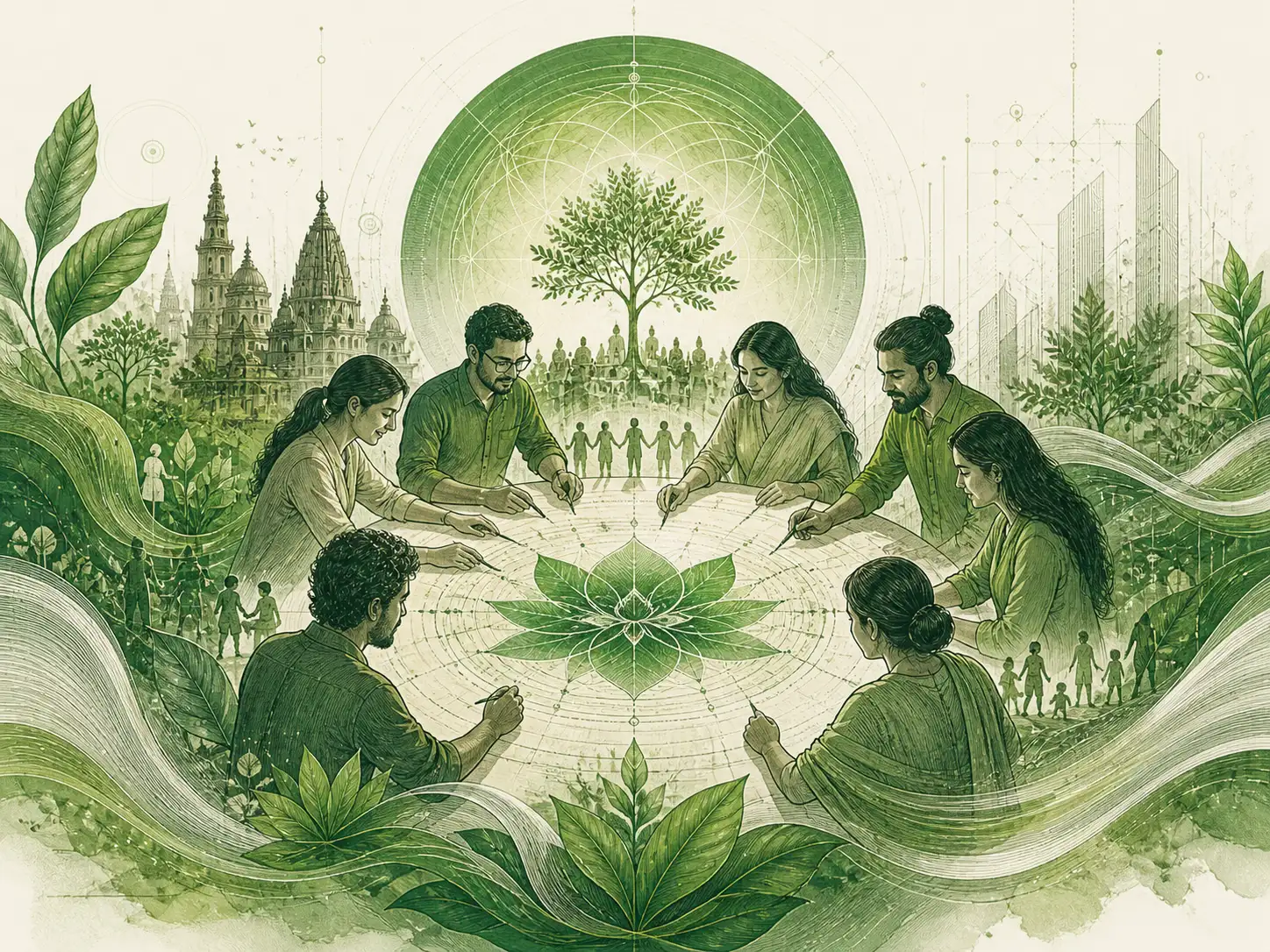
Whitepaper on Dharmic Design
This whitepaper asserts that modern design, in its obsession with anthropocentric convenience, has lost its ethical and cosmic tether. To rectify this, we propose a shift toward Dharmic Design.
The contemporary global landscape is characterized by a deepening crisis of design - a systemic failure born of reductionist, linear, and utilitarian paradigms. While the industrial and digital revolutions have yielded unprecedented technical efficiency, they have simultaneously birthed a triad of existential threats - ecological collapse, driven by an extractive logic; digital toxicity, fueled by manipulative engagement metrics that prioritize profit over cognitive health; and a profound ontological alienation, where the built environment and digital interfaces are decoupled from the human spirit and natural order.
This whitepaper asserts that modern design, in its obsession with anthropocentric convenience, has lost its ethical and cosmic tether. To rectify this, we propose a shift toward Dharmic Design. Rooted in the philosophical pillars of Ṛta (cosmic order) and Dharma (ethical duty), Dharmic Design offers a sophisticated, non-Western framework for innovation. By transitioning from design as an act of control to design as an act of alignment, we can move beyond mere sustainability toward a regenerative, “satvik” future. This whitepaper outlines the philosophical bedrock, historical precedents, and actionable methodologies required to operationalize dharma as a universal design standard for the 21st century.
To understand the necessity of a Dharmic approach, it is essential to contrast it with the dominant Western design paradigms that have shaped our modern infrastructure and digital ecosystems.
| Dimension | Western / Reductionist Paradigm | Dharmic / Integrative Paradigm |
|---|---|---|
| Philosophical Root | Anthropocentric: Design centers on human desire and immediate user convenience, often at the expense of the periphery. | Cosmocentric: Design centers on the individual’s resonance with the cosmic order (Ṛta), recognizing the self as a microcosm of the whole. |
| Temporal Logic | Linear: Focused on the immediate product lifecycle, quarterly growth, and planned obsolescence. | Cyclic / Karmic: Focused on the eternal recurrence of cause and effect; designs are evaluated by their multi-generational impact. |
| Material Relationship | Extractive: Nature is viewed as a resource “inventory” to be managed, optimized, and consumed. | Elemental (Pancha Bhuta): Nature is an extension of the self; materials are sacred constituents to be harmonized, not just used. |
| Primary Metric | Utility & Profit: Success is measured by efficiency, friction-reduction, and ROI. | Balance & Harmony (Samatva): Success is measured by the restoration of equilibrium and collective welfare (Lokasangraha). |
| Ethical Framework | Rights-Based / Legalistic: Adherence to external regulations, safety standards, and user rights. | Duty-Based (Dharma): Adherence to internal ethical responsibility; design is viewed as a moral act with karmic consequence. |
| Digital Intent | Attention-Driven: Uses “dark patterns” and neuro-hacking to maximize time-on-device for data extraction. | Cognitive Purity (Sattvic): Prioritizes mental clarity (Chitta-Shuddhi), transparency (Satya), and non-harm (Ahimsa). |
The current design orthodoxy suffers from an architectural and digital tamas - state of inertia and ignorance regarding systemic consequences:
- Ecological Fragmentation: By treating the environment as an “externality,” modern architecture and product design have disrupted the Pancha Bhuta (the five elements). This has resulted in a built environment that is often bio-antagonistic, requiring massive energy inputs to remain habitable.
- The Ethics of Disconnect: In the digital realm, the decoupling of action from consequence - a violation of the law of Karma - allows for the creation of algorithms that spread misinformation and social discord without immediate accountability for the designer.
- The Loss of Sacred Proportion: Modern utilitarianism has stripped design of its symbolic and metaphysical potency. Where the Shilpa Shastras once used geometry to connect the human to the divine, modern design often produces “non-places” that contribute to a global crisis of loneliness and meaninglessness.
Dharmic Design is a strategic imperative for a future that requires a more robust ethical and systemic “operating system.”
The Philosophical Core
The foundation of any discourse on dharmic design rests on Hindu metaphysics, which provide the ontological and ethical frameworks that underpin the entire concept. These sources articulate a worldview where cosmic harmony, ethical duty, and interconnectedness are the fundamental principles governing existence. The central proposition is that true design aligns with Dharma, whereas destructive acts do not. This requires a shift from viewing design as a purely technical or aesthetic exercise to seeing it as an ethical act with consequences.
The primary challenge for contemporary application is to translate these ancient, often symbolic, concepts into a coherent language for modern design practice across diverse fields.
At the apex of this philosophical structure lies the concept of Ṛta, a term denoting cosmic order, regularity, balance, and truth. Described in Vedic literature as a regulator and stabilizer of all phenomena in space and time, Ṛta represents the inherent natural law that governs the universe.
A dharmic approach to architecture, for instance, would prioritize designs that enhance health and well-being by integrating with environmental factors, thereby contributing to cosmic harmony rather than disrupting it. An algorithm designed with Ṛta in mind would be one that promotes informational stability, prevents chaos, and upholds truthfulness. The Rta-Resonance Management (RRM) theory, which seeks to redefine organizational success by measuring its resonance with this cosmic order, provides a direct model for evaluating the systemic impact of any designed artifact or process.
Dharma is consistently defined as “right conduct,” ethical duty, and living in alignment with the cosmic and moral order - a subtle and complex principle to discern. For a designer, Dharma establishes a framework of responsibility that extends beyond the immediate user to encompass the broader community and environment. The interplay between Dharma and Karma is crucial, creating a moral feedback loop that must be considered throughout the design lifecycle. A product’s design is incomplete without considering its end-of-life disposal, as the waste it generates carries karmic weight. The Dharma Framework for Decision-making and Governance (DFDG) showcases an attempt to operationalize this by framing decisions within an intricate, embedded relationship between humans and their environment, emphasizing an ethical base for national integrity.
A third pillar of the philosophical foundation is the principle of interconnectedness, articulated most clearly in advaita. The emphasis is on self-inquiry, the unity of all existence, and the deep connection between the microcosm and the macrocosm. Humans are understood to be composed of the same essential five building blocks of reality - pancha bhuta - giving a direct link between inhabitant and inhabited space.
Finally, dharma’s ethical framework provides a rich vocabulary for responsible design, drawing on principles such as satya, loka sangraha, and seva. By grounding design in these classical philosophies, a dharmic approach seeks to create solutions that contribute to the long-term well-being of society and the planet, moving towards a regenerative purpose. Dharmic design actively seeks a restraining order on accelerationism, disruptive innovation, moving fast and breaking things.
History of Dharmic Design
The design principles of rta and dharma were translated into tangible forms most prominently within the disciplines of architecture and art. The philosophical principles of Ṛta, Dharma, and Pancha Bhuta were not merely abstract concepts but were systematically translated into tangible forms, most prominently within the disciplines of architecture and art. The classical treatises on Vastu Shastra and Shilpa Shastras provide detailed, rule-based methodologies for creating spaces and objects that embody cosmic harmony and spiritual potency.
Vastu Shastra principles are deeply rooted in the desire to live in resonance with the cosmos. The methodology is multifaceted, beginning with site selection, which involves careful consideration of factors like soil quality, water sources, and landscape contours, as described in texts that differentiate between various types of soil based on color, density, and moisture content. Once a site is chosen, the design process emphasizes cosmic alignment, orienting buildings according to cardinal directions to optimize the benefits of natural light, wind, and solar energy. The core of Vastu design is the Vastu Purusha Mandala, a metaphysical square grid that serves as the fundamental blueprint for temples, homes, villages, and even entire cities. This mandala represents a cosmic man flattened onto a grid and is used to map out every element of the structure, ensuring that each part corresponds to a specific deity or cosmic force, thus imbuing the entire space with sacred geometry and symbolic meaning. The ultimate goal of this meticulous process is to enhance the health, well-being, prosperity, and overall quality of life for the occupants by creating a space that is in tune with both gross and subtle natural energies.
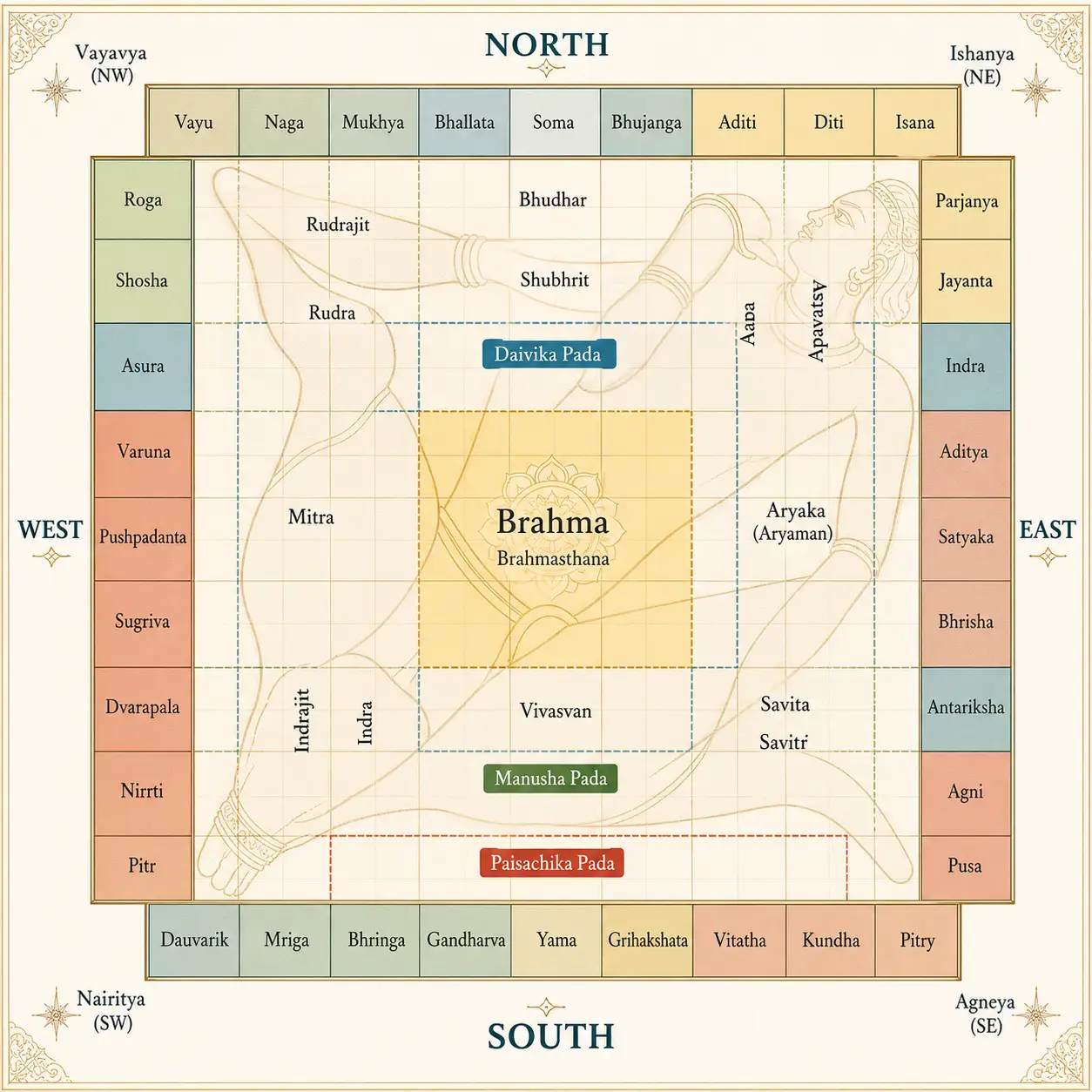
Complementing the spatial science of Vastu Shastra is the artistic tradition of the Shilpa Shastras, which focuses on the creation of religious icons, sculptures, and temple art. While Vastu deals with the “how” of building, the Shilpa Shastras deal with the “what” and “why” of the objects placed within those spaces. This field is characterized by an emphasis on iconometry- strict adherence to geometric proportions and measurements for creating deities and other sacred images. These rules are to ensure that the created image is spiritually potent, serving as a proper conduit for divine energy. The root of the Sanskrit word for image, citra, is √cit - consciousness, making citra literally mean an “instrument of consciousness” - an indication, among other things, of how seriously to take the creator’s responsibility.
The Shilpa Shastras’ concern is purity and accuracy - mass-produced items that distort sacred forms or mix iconography inappropriately are discouraged in favor of handcrafted pieces that honor the story and symbolism behind them. This principle has broad implications beyond sacred art, suggesting that any design process - from furniture to software - are elevated by rigorous attention to proportion, material integrity, and the intentionality behind its creation. It discourages design away from a disposable, mass-market culture toward one that values craftsmanship and enduring symbolic meaning.
These classical design principles were applied at the scale of urban planning. Ancient Indian towns and cities were planned with a clear moral and philosophical perspective, integrating Hindu ethics into their very layout. The walled city of Jaipur, for example, is a planned urban system based on the principles of Vastu Shastra. The systematic layout of streets, the placement of public and private spaces, and the orientation of structures all reflect an attempt to create a harmonious and functional community. This historical precedent suggests that dharmic principles can serve as a viable framework for modern urban planning, offering an alternative to car-centric, economically driven development models. The influence of Indic cosmology and architectural design, derived from Vastu Shastra, can even be traced in the Angkor region of Cambodia, where elements like square layouts and temple orientations show clear roots in these ancient traditions. This cross-cultural diffusion highlights the enduring power and appeal of a design philosophy grounded in universal cosmic principles.
Dharmic Design Today
Modern dharmic design will have to inform two critical domains - the development of artificial intelligence (AI), and the practice of sustainable urban planning and architecture. We will have to move from literal application to conceptual translation, extracting timeless principles of ethics, ecology, and interconnectedness to guide innovation and creatorship. The core idea is that as technology becomes more pervasive, it requires a new kind of ethical compass. In his book The Dharma of AI, Alok Caturvedi writes -
We’re living suspended between two worlds - one where AI quietly decides who gets hired, what news we see, and which voices we hear - and another where millennia of human wisdom sit waiting to guide us. Our digital future desperately needs our philosophical past.
Adhikari, Shrestha, and Neupane agree with our assessment that the current move fast and break things approach to technology and innovation is a significant threat to humanity, adding that this is especially so when AI is considered to be a civilizational-altering technology. They query the Bhagavad Gita as a framework for a ‘Sattvic AI,’ artificial intelligence aligned to sustainable development. Their conceptual synthesis proposes Dharma to redefine AI’s purpose, Nishkama Karma to discipline AI development, and the triguna framework to evaluate AI impact.
Vastu Shastra itself is being reinterpreted and applied to modern solutions for lighting, ventilation, local materials construction. Vastu is future-ready, its core principles and larger integrality making it relevant in a future of biophilic design, wellness architecture, and off-planet habitats.
In product design, intentionality and material integrality from the Shilpa Shastras could foster a rejection of disposable culture.
In UI/UX design, the dharmic lens would prioritize user well-being over manipulative engagement metrics. An interface that avoids dark patterns, promotes real-world living as much as it does its own screen - these are real possibilities for technology paths we can take right now. In this video Anjan Katta paints a vivid picture of what things could look like if our entire product development, innovation, and tech stack were informed by a different kind of consciousness and incentives.
Here, dharmic design is in powerful alignment with existing initiatives like the Center for Humane Technology, which frames its core question as -
How can technology better serve society?
Bridge to the Real World
The task ahead for a think tank initiative such as designBodha is to bridge the gap between abstract principles and actionable methodologies. The first step is a standardization of terminology and construction of early layer tools that operationalize dharmic design concepts in the real-world.
Creating the foundational lexicon is essential. For actionable design the terminology must overcome Sanskrit’s internal symbolic nature and - in some cases - lexical depth. How would we translate loka sangra to user safety protocols or bias mitigation. How would the very metaphysics underpinning karma branch into modern dharmic design principles?
Beyond that, practical credibility would come only through pilot projects, case studies and real-world efficacy. The designBodha work has just begun…
Critical Gaps
- Lack of a unified, practical framework that systematically translates Dharmic metaphysics into a modern design methodology.
- Much of the existing work remains at a high abstraction level - inspirational principles without concrete tools.
- Insular developments without a larger, productive dialogue with established design fields.
- Possibility of (re)introducing dharmic ethics as new prescription layers, only creating a design orthodoxy.
- Urgent need for empirical seasoning and validation. The claims around dharmic design are currently anecdotal or philosophy-located.