

Bodha Knowledge Base
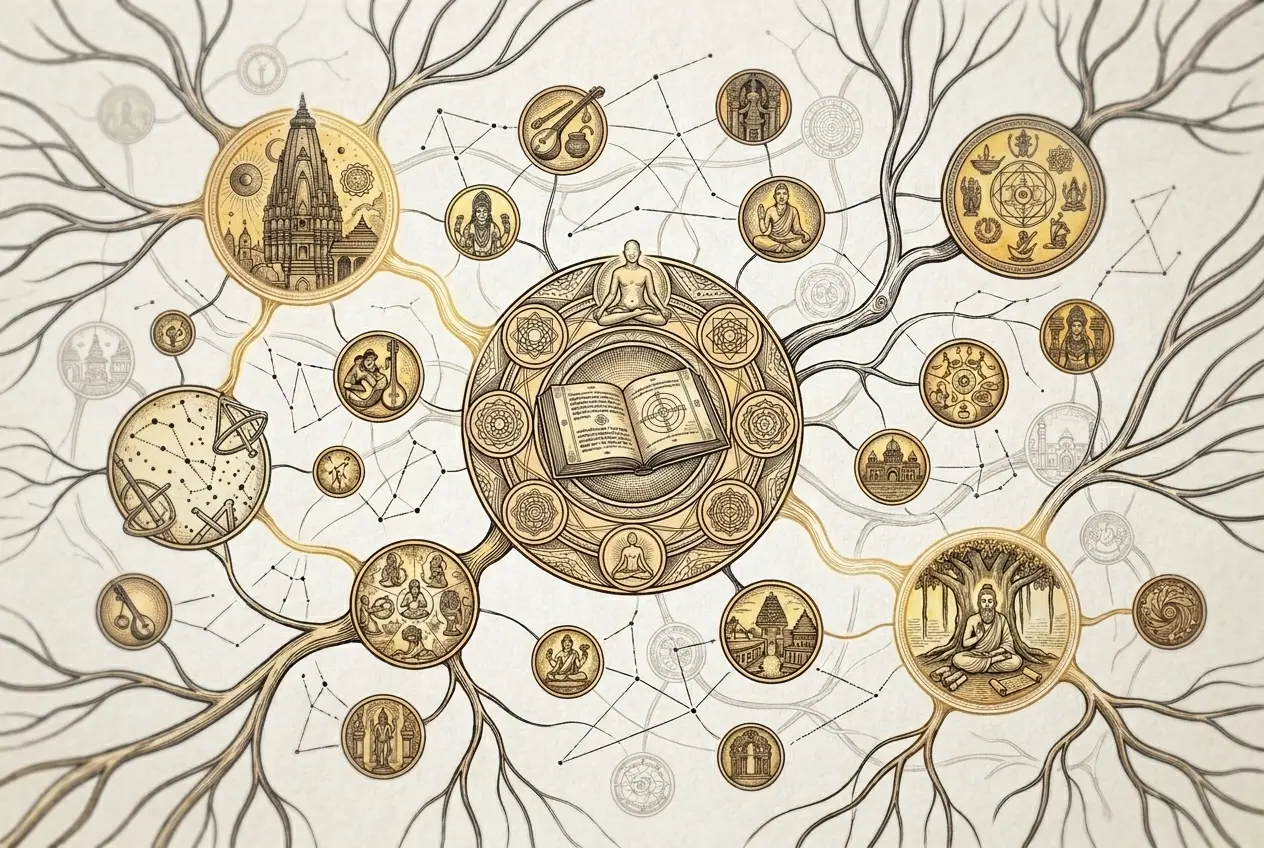
An interactive map of the Bodha knowledge base. Nodes are thinkers, schools, questions, wiki pages, and research projects. Edges show how they connect — who draws on whom, what addresses what, which schools a thinker belongs to.
At Bodha, we're nerds about archives, knowledge bases, wikis, and repositories. Our ambition is to create a platform for discovery, learning, and research of all things itihasa, Bharata, Dharma, and the Indian Knowledge Systems (IKS).
To this end, the Bodha knowledge wiki is an information and data architecture that facilitates discovery paths for the curious and interested.
It is the central organizing point for - 1) all content at our website, and 2) all general internet content that we curate and list.
Explore by Domains
Domains are thematic supergroups used to organize content across the website.
View Graph
The wiki visualized in graphs and nodes.
Temples Repository
300+ and growing registry of Hindu temples across India, major deities, and architecture.
IKS Wiki
Search through IKS journals repository, updated monthly.
Domains
Civilizational Consciousness
The framework itself — svayambodha, civilizational-consciousness, ecology as worldview, the dharmic response to modernity, and the meta-question of how a civilization understands itself.
89
connections
Indology & Civilizational Critique
Purva-paksha and shatrubodha — the critique of Western Indology, the missionary and Islamist challenge, intellectual sovereignty, and the analytical tradition of Voice of India.
69
connections
Sindhu-Sarasvatī & Origins
The question of civilizational origins — Indus-Sarasvati civilization, Out of India theory, the Aryan debate, ancient genetics, Indo-European linguistics, and Vedic archaeology.
37
connections
Darśanas & Philosophy
The six schools and their offshoots — Nyaya, Vaisheshika, Sankhya, Mimamsa, Yoga, Vedanta — plus Kashmir Shaivism, Buddhist and Jain philosophy, and the broader Sanskrit philosophical tradition.
35
connections
History & Civilizational Recovery
India's historical self-understanding — indigenous historiography, the Dharampal tradition, the Beautiful Tree, recovery of pre-colonial knowledge, and the critique of colonial history writing.
35
connections
Purāṇas & Itihāsa
The narrative inheritance — Mahabharata, Ramayana, the eighteen Puranas, and adjacent texts like Katha Sarit Sagar. Sacred time, cyclical history, and the mythic imagination of Bharata.
25
connections
Festivals & Living Tradition
The lived religion — festivals, utsavas, ritual cycles, temple-going, Navadurga, and the practice of civilizational reconnection through tradition.
24
connections
Dharmaśāstra & Polity
The normative order — Smriti, Dharmashastra, Arthashastra, and the broader tradition of Hindu statecraft, law, governance, and political ethics. How dharma structures collective life.
22
connections
Indian Knowledge Systems and Education
Indian Knowledge Systems across Amarakosha, Hindu mathematics, science, the 64 kalas, and civilizational learning.
19
connections
Arts & Aesthetics
The aesthetic tradition — Natyashastra, rasa theory, music, dance, drama, iconography, architecture, and the philosophy of art and meaning-making in the Indian tradition.
17
connections
Śruti & the Vedic World
The foundational revelation — Vedas, Upanishads, Aranyakas, Brahmanas, and the interpretive traditions that receive them. Includes Rigvedic symbolism, Vedic cosmology, and the seer tradition.
14
connections
Language & Sanskrit
The science of language — Sanskrit grammar, linguistics, philosophy of language, Bhartrhari's sphota theory, the Amarakosha as knowledge structure, and Sanskrit as civilizational medium.
11
connections
Sacred Geography & Temple
The sacred landscape — temples, tirthas, kshetras, Dharmic circuits, pilgrimage traditions, and the Agama as the living science of sacred space and ritual.
11
connections