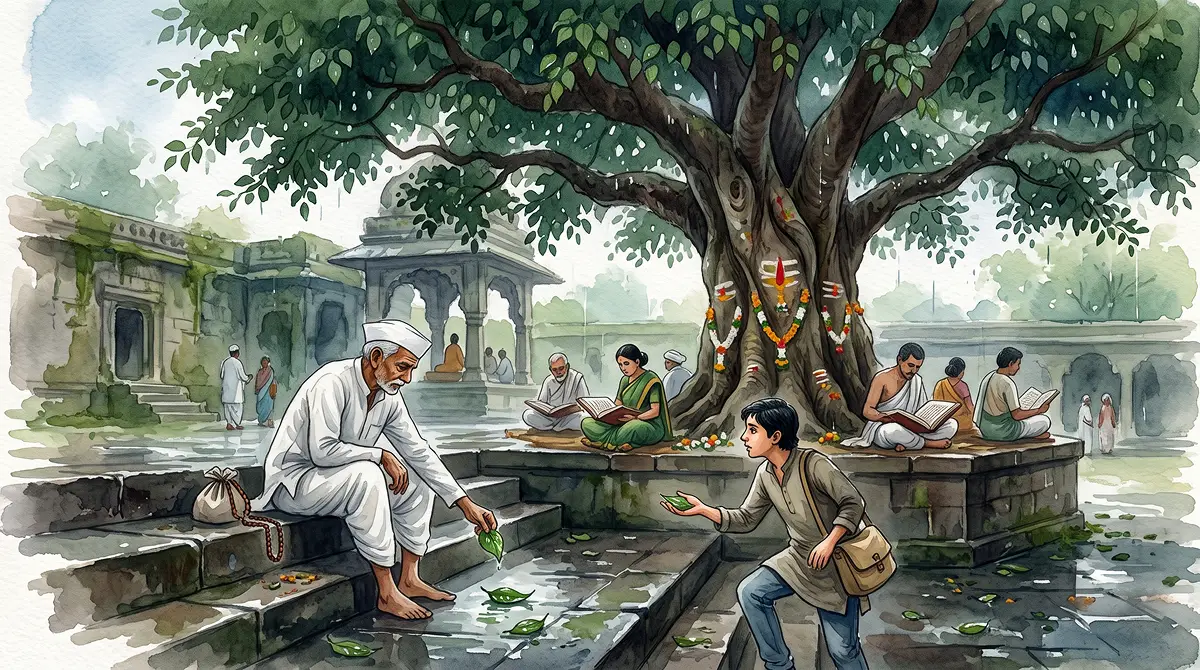
I was sitting on the stairs near the office inside the campus of the Samadhi mandir at Alandi. I saw an old man sitting beside me. In front of us was the tree named Ajanvriksha – with her branches spread out, forming a canopy. It had rained a bit, and the floor was somewhat wet. Fresh-green coloured leaves of the tree, glistening with rainwater, were falling once in a while. The man got up from the stairs and quickly picked up a leaf. I saw him do that maybe a couple of times, and then decided to collect the next leaf for him as it fell. Researchers doing fieldwork might seldom sit silently, I guess. Or was it just me who was trying to comprehend the field by interfering in its usual, everyday currents? I was spending my time at Alandi – visiting Samadhi mandir – sitting there for hours and waiting for ‘something to happen’ or at least to observe ‘something important’ in the life of the mandir. I might have been visualising the field as a multi-layered reality, with the surface layer composed of easily visible components. Beneath it laid much more complex, abstract layers that required a certain form of active interference for comprehension. So, I quickly got up from the stairs, picked up one leaf from the wet floor and gave it to the man who was collecting it. He didn’t accept it. He said, “You keep it, it is yours… You have collected it.” I was a bit confused about what I was supposed to do with the leaf. While I was taking a moment or two to figure out what to do with the leaf, I realised I had failed at the drill. Hence, I asked the man, “Why are we supposed to collect it?” He instantly replied, “Keep this with you, and eat it before you start reading Jnaneshvari (a retelling and commentary of Srimad Bhagvad Gita by Sant Jnaneshvar Maharaj). The leaf helps in jnan-prapti (attaining knowledge); it will make you understand Jnaneshvari better.”
A Tree in the Life of the Varkaris
I kept the leaf in my hand and tried to continue the conversation with the old man. I was hoping to explore and know about a couple of more domains of the Varkari tradition. But the talk really did not last long. As I got up from the stairs, I remembered once my school friend who had visited Alandi told me about a tree below which you are supposed to sit and read Jnaneshvari. I realised she had talked about the Ajanvriksha. I walked towards the tree and climbed a few stairs to reach its trunk. People were touching foreheads to the trunk, bowing before the tree, performing all the theatrics of taking darshan. Many were sitting and reading Jnaneshvari on the raised platform near the trunk, which might have been built for the same purpose. There was blissful silence that filled the air, and time paused for a bit near the Ajanvriksha. As I climbed down from the other side of the platform, there were some men and women sitting in line engrossed in reading the text. On enquiring about the significance of the Ajanvriksha to one of the members of the tradition, I was told that this tree was born from a stick that Jnaneshvar Maharaj firmly fixed in the ground while going in a trench-like structure made for him to enter the state of Sanjeevan Samadhi.
As Namdev Maharaj noted in one of his abhangas (a form of Bhakti poem of the Varkari tradition):
ज्ञानदेव बैसले समाधी| पुढे अजान वृक्षनिधी |
Jnandev baisale samadhi | Pudhe Ajanavriksha nidhi ||
Meaning - Jnandev is seated in Samadhi, and before him is the precious Ajanvriksha. The stick developed roots and shoots as well, growing eventually into a tree. This stick, apparently, was made from the tree which had sanskara or impressions of the sadhana (disciplined practice to attain adhyatmik goals) of eighty-four siddha yogis. Furthermore, as I was walking in vari (the Varkari tradition’s practice of walking towards Pandharpur), a lady told me a story associated with the tree. Many years after Jnaneshvar Maharaj took Samadhi, Alandi was losing its glory. The place of Samadhi was not maintained and Ajanvriksha’s roots eventually reached Jnaneshvar Maharaj’s body. Hence, once Jnaneshvar Maharaj came in the dream of Eknath Maharaj and told him, “One of the roots of the Ajanvriksha is tangled around my throat”. He asked Eknath Maharaj to remove it. Hence, Eknath Maharaj found the Samadhi spot and later removed the root. The story is captured by Eknath Maharaj himself in an abhanga displayed at the Samadhi mandir premises at Alandi:
श्रीज्ञानदेवें येउनी स्वप्नांत । सांगितली मात मजलागीं ॥१॥
दिव्य तेज:पुंज मदनाचा पुतळा । परब्रह्म केवळ बोलतसे ॥२॥
अजानवृक्षाची मुळी कंठास लागली । येऊनि आनंद स्थळीं काढ वेगीं ॥३॥
Shri Jnandeve yeuni svapnant ।Sangitali maat majalagi ॥1॥
Divya tejaḥpunja madanacha putala ।Parabrahma keval bolatase ॥2॥
Ajanavrikshachi muḷi kanthas lagal । Yeuni ananda sthali kadh vegi ॥3॥
Meaning - Shri Jnaneshvar came into my dream, and spoke these words to me. He was a radiant mass of light, a form of surpassing beauty, speaking as the Para-Brahman itself. “The roots of the Ajanvriksha have reached my neck; Come at once to this sacred place of bliss and remove it quickly.”
Ajanvriksha as a Silent Force
In a world filled with diverse trees, what does it mean to be Ajanvriksha? What makes the tree different from the trees that are perceived as ‘ordinary’? What do the stories of the past do to the tree in the present? What effect does the tree produce in the Varkari world? These are the questions that come to my mind after mulling over the discourse around Ajanvriksha in the Sampradaya. As we have already seen, the Ajanvriksha acts as a window to the past of the Varkari tradition. As it inhabits the reality of the Varkari world, the tree crystallises a fragment of time in material form. Its leaves sing the songs of Bhakti that emerged on the day Jnaneshvar Maharaj went into Samadhi. The roots link the Bhakta with the eternal bliss that the saint embodies. The trunk extends and makes accessible the sacred presence of Jnaneshvar Maharaj to people. The intrinsic piousness of the tree due to the previous sanskaras increases because of its contact with the saint’s body. Hence, touching the bark of the trunk is being connected with his sacred presence. The tree hence foregrounds the intangible through its features that are tangible. It emerges as another focal point of the temple premises, adding one more sacred element to its geography. Maybe this is why people sit under it to read Jnaneshvari. It not only connects people to saints but also directs them towards knowledge. It acts as a force that gathers people at the temple, transforming it into a learning space. Consequently, it enables the formation of a community of learners. Eating a leaf before reading Jnaneshvari makes the tree a facilitator of attaining knowledge, weaving it into the network that connects Bhaktas, the saint, and the wisdom of the tradition. By anchoring people in the act of reading Jnaneshvari, it not only guides them towards the saint in Samadhi but also to the possibility of attaining such a state for themselves. Hence, the tree serves as a reminder to experience one’s true nature.
Hence, in the Varkari Sampradaya, the understanding of the Ajanvriksha speaks of the underlying adhyamta (referring to the search for and realization of ultimate reality). The reverence towards the tree in the tradition’s everyday life arises from an adhyatmik context. It is within this context that the understandings of sentience and agency regarding the tree make sense in the tradition. It is not that Ajanvriksha is ontologically different from other trees, the saint or us in the adhyatmik plane. As per the Advaita Vedanta position of the Varkari Sampradaya, in the adhyatmik plane, there is no bhed (difference or division) between beings; all beings share the same ultimate reality. But to realise and experience it, one must follow certain practices in the vyvaharik (roughly translating to the practical domain of the material world) plane. And revering the Ajanvriksha is one of them. The uniqueness of the Ajanvriksha, therefore, does not lie in a different ontological status but in the role it plays within the vyavaharik world as a material locus through which Bhaktas can cultivate and realise the non-duality.
The Adhyatmik Deficit in Academia
Why did I choose to talk about the tree today? Maybe because the narrative associated with Ajanvriksha is surprising in more than one way. Maybe nobody talked about a tree of the Varkari tradition before. Maybe because the discourse around the trees of the Bhakti world is absent. Researchers often prioritise topics that are of interest to academia. The trends in academia might direct or, at times, limit researchers’ attention only to certain lines of inquiry. One might find oneself stuck only in the contemporary debates of academia. I might have unknowingly done that. I might have chosen to focus on a tree of the Varkari world, inspired by the non-human turn in multiple academic disciplines. Various non-human entities which held a position at the margins of inquiry in Social Sciences and Humanities research are being placed at the centre. Such elements, which previously might have been the objects of inquiry, are now increasingly being conceptualised as subjects possessing agency and sentience. This turn is also based on the critique of social constructivism, which reduces the understanding of diverse cultures about the non-humans to nothing but social constructions. We can see that academia has just started catching up with the different realities of people, considerably extending its boundaries of knowledge. Yet the disciplines remain largely devoid of the adhyatmik logics of Hindu traditions. This raises a question: Will Social Sciences and Humanities ever feature the adhyatmik core of traditions like those of Bhakti? Is academia, after all, ready for an adhyatmik turn? Moreover, can such a turn really emerge if it remains within the epistemological frameworks of the Western intellectual traditions? Or the turn will demand frameworks to seek knowledge that are resonant with the particular tradition’s philosophies? Such a turn cannot limit itself to identifying the adhyatmik aspect of its practices and engaging with it at the level of interpretation alone. It also demands adhyatma to be a source of methods of theory-building and knowledge-seeking. This might potentially redesign how we do Social Sciences and Humanities.