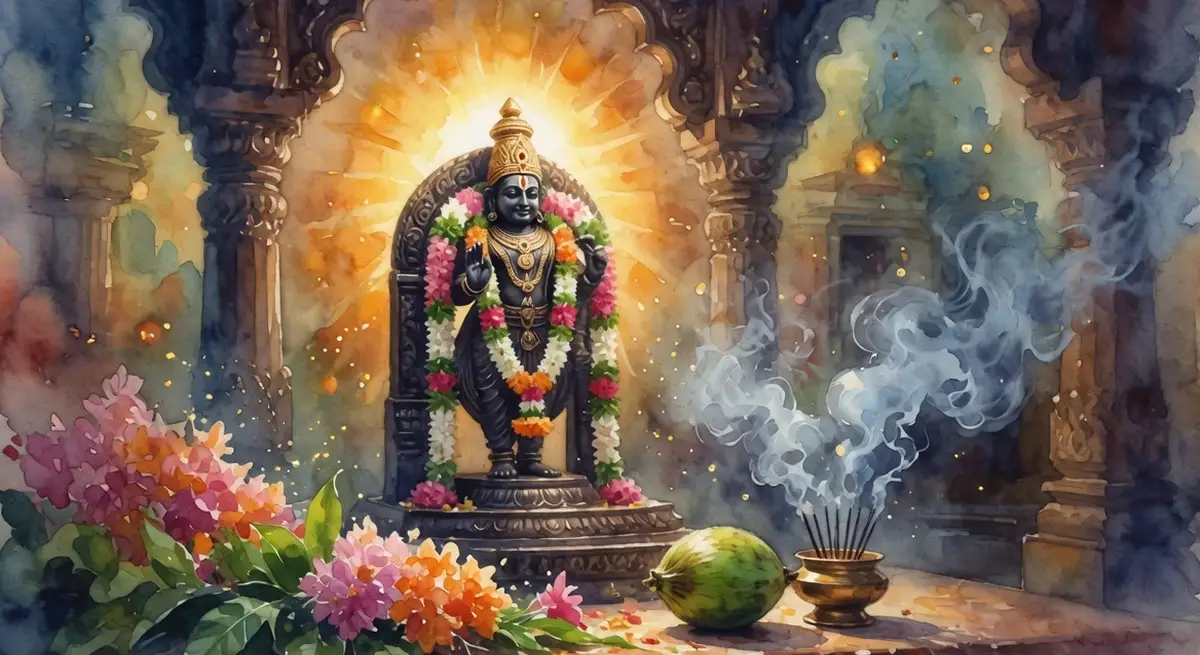
Mahalasa Narayani Temple is one of the busiest temples of Goa, and also one of the most beautiful. The Mohini incarnation of Lord Vishnu is worshipped here as Shri Mahalasa. Legend has it that Lord Shiva was once enchanted by the charm of Mohini, who promised him that in a future age, he would incarnate as Martanda Bhairava and she would be born as Mahalasa, at which time they would be united in marriage. According to another legend, Parvati, the consort of Lord Shiva, was born as Mahalsa and appeared before Shiva in a form as beautiful as Mohini when Shiva was in his Khandoba form. Thus Shri Mahalasa again remains associated with Mohini incarnation of Lord Vishnu.
The migration of this deity from Varunapur (also known as Vernem, or present-day Old Mardol) to its current location at Mardol in Ponda Taluka is believed to have occurred by the mid-sixteenth century, although no definitive records exist to confirm this. However, it can be reasonably concluded that the relocation took place around the time when Christian missionaries began their vigorous conversion activities in the island of Goa, soon after it came under Portuguese rule.
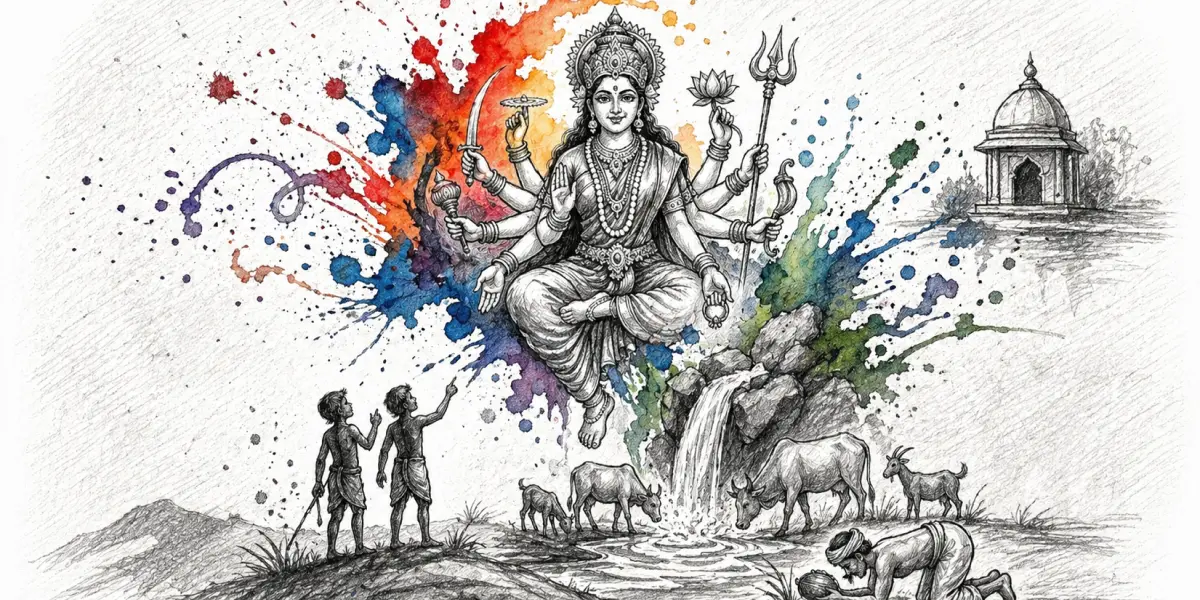
The stahala purana says that on one sunny day, a cattleherder was resting under a tree shade on a nearby hill, watching over his cattle. While giving a call to his herd to take them to water, he saw a sudden flash of light and a radiant figure of a Goddess emerged from that flash. The Goddess expressed her desire to dwell in that spot and asked the boy to bring the village landlord to the spot. The boy said that he has to finish watering his cattle. Upon seeing his reluctance, the Goddess lightly struck the earth with the ring in her toe (nupur) and with that gentle flick, a gush of crystal clear blue water sprang up from under that solid black laterite rocky earth. The cattle began drinking the water, and the cattle boy ran down the hill in excitement. The landlord was not at home, so the son-in-law of the household accompanied him up the hill. Upon witnessing the divine, he prostrated himself on the ground in complete submission. The Goddess reiterated her desire to remain at that spot, instructing him to unearth the place to find her murti and build a temple for her, before disappearing.
As the legend has it, Shri Mahalasa arrived at Vernem plateau on that day. The tale continues to be passed from generation to generation. A tank with a perennial spring of water, existing from times unknown, on the hillock of Vernem in the vicinity where once stood a magnificent temple of Shri Mahalasa, is known as Nupur Tali or Nupur tank deriving its name from the legend.
This endearing legend so woven into the regular life of villagers finds itself repeating in several other places.
In a curious case associated with the Shri Navadurga Temple at Madkai, the story goes that there is a place known as the Prakat Sthanam on the other side of a nearby hill. At that spot, the footprints of the Devi are engraved on a stone, over which a small dome has been built. There is a small lake nearby, known as talai khol.
About 350 years ago, a woman dressed in local attire, wrapped in a blanket, appeared at that very spot. Several young cowherds were present there with their cows and goats. She asked them to call the local landlord to the place. One cowherd boy, named Lokhano, told her that he needed to take his cattle to a water body and did not have time to fetch the landlord.
The lady replied that she would take care of the cattle herself. She then touched the ground with her foot, and a spring of water emerged. The cowherd realized that she was no ordinary woman. He ran to the village and returned with the landlord and other villagers.
Upon arriving, they witnessed the beaming presence of the lady and prayed to her. The woman then revealed herself to be Navadurga herself. The landlord requested her to command them. The Goddess gave him a coconut and instructed him to throw it toward the village and build a temple for her at the spot where it would land. Having said this, she disappeared before everyone’s eyes.
Even today, every villager of Madkai remains deeply connected to the temple and this legend, while also being familiar with the legend of Mahalsa.
It is fascinating to see the parallels between these two Goan legends. Both involve a thirsty herd, a devi, and the miraculous creation of a spring from the earth to prove her divinity.
These parallels in the story are not limited just to the origin of the temples. Even the historical account of migration of deities from the coastal side to the interior parts of Goa during the Portuguese invasion has a lot of similar tales of bravery of devotees, their struggle and resettlement of their deity at a different place.
As Pankaj Saxena observes, “The legends that are true at a bigger level mutate and reappear slightly differently but markedly similar in meaning and purpose at every level, like fractals.”
Our culture sacralizes the kshetras and daily lives by retelling the legends. Our methods of worship are similar to how devatas and rishis worshipped the great Gods. The marriage rituals are often imitations of wedding rituals of Shiva - Parvati and Rama - Sita.
This also follows the inheritance logic of coding where a story can be a derivative of an original story with addition of local flavors. Not everything needs to be new, tradition reuses/follows what already exists. And the same or similar stories are retold to keep the cultural memory relevant and alive. This holds true for our epics, our history and lessons which we pass down to the next generation. As these stories are the one which binds the omnipotent goddess to the local people.