There is something clarifying about working through the Sanskrit roots of things. The roots (or dhatus) disclose what concepts are, at their core, before centuries of colonial translation and administrative appropriation stripped them of their original content. When we begin with these concepts, rather than the Western notions, something changes in how we uncover and understand things. In this essay, we will do so for a question that humanity’s presence persistently asks, and has been answered quite poorly in recent centuries
what is a civilization?
The standard response locates civilization in its hardware cities, writing systems, centralized authority, surplus agriculture, long-distance trade. By this accounting, civilization is a logistics problem solved when you have enough stuff organized in enough rows. The Sindhu-Sarasvati Valley had drainage systems, ergo civilization. Rome had aqueducts, ergo civilization. The implicit metaphysics here is entirely material. A civilization is a high-density arrangement of things and people. It begins when the arrangement achieves sufficient complexity and ends when the arrangement collapses. This is not entirely wrong, but it is tragically incomplete. It’s the kind of description that tells you much about the brick, but little about the house.
We might be better led if we framed our query teleologically what is a civilization for? What do humans aggregate in larger and larger numbers for? Once we ask this question, we find that an evolved answer to this was worked out in Paninian grammar and by extension in the civilization that sprung it. In the Arthashastra, in the classifications of the Amarakosha, in the axioms of the Dharmashastras. In a philosophical tradition that approached civilization as a metaphysical problem. One that asked, before deciding how to organize a society what is the nature of the conscious beings who will inhabit it? And so in our query the preambulatory question is:
What Makes a Human?
Now, though we readily take this for granted, we are not exceptionally different or unique among the life forms of this planet. On language monkeys have differentiated alarm calls distinct sounds for aerial predators, terrestrial predators, other monkeys playing false alarms. Dolphins carry regional accents and dialects. Birds possess the structural building blocks of language. We are not uniquely dextrous either crows solve multi-step physical problems, chimpanzees and orangutans craft instruments, otters use stones, monkeys search deliberately for rocks that will serve as hammers. Even social engineering or emotional complexity aren’t our preserve. Ants build cities of extraordinary structural complexity, farm other species, manage resource flows, and coordinate at scales that dwarf many human settlements. Elephants mourn their dead. Baboons form patron-client hierarchies with other species. Bowerbirds make aesthetic judgments. Every categorical border we draw between ourselves and the animal kingdom turns out, on inspection, to be a gradient rather than a wall.
So what, precisely, is different? The answer to this may come from examining what, precisely, did we start doing differently and unique and what consequence it had upon our lives.
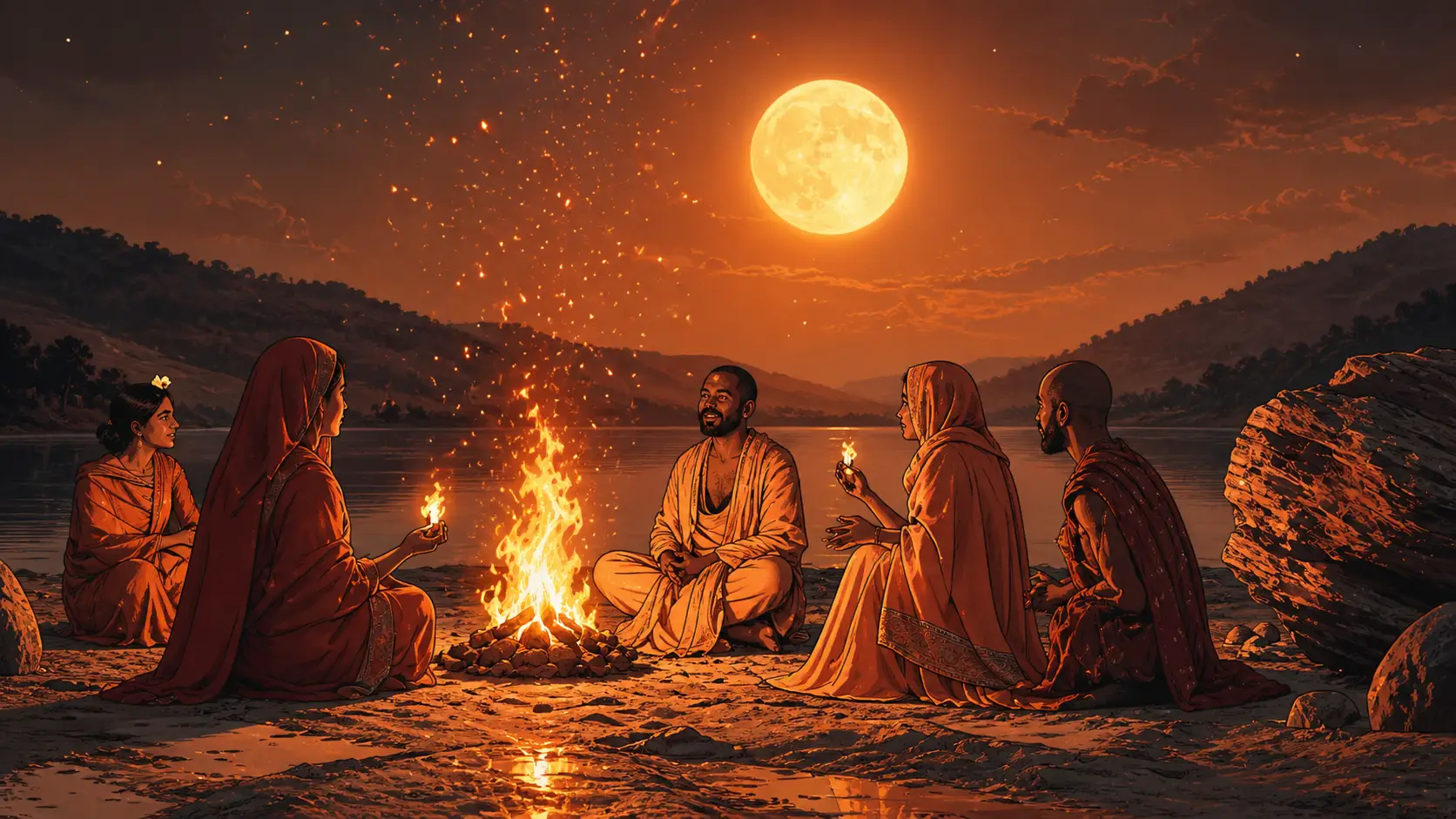
The wheel and controlled fire are candidates for the earliest distinctly human technologies, especially for what they enable. Shape-manipulation gives mobility, energy multiplication, and new forms of creation. Environment-manipulation through fire gives safety from predators, yes, but also something stranger and more consequential time. Humans sat around the fire at night. They had hours of warmth and light without threat, hours with no survival task to perform, hours that required filling with something other than vigilance. Those hours became stories. Those stories became the first scaffolding of culture. And the extra time we unlocked, in turn, unlocked a most unique and enduring trait of the homo sapien transmission among the generations.
Creativity, innovation, communication, cooperation none of these are uniquely human. What is uniquely human is the ability to consciously pass on creativity. The lioness cannot deliberate with her cub on which prey to select. The gorilla cannot instruct her young on which fruits are sweetest by any means more sophisticated than demonstration. In humans, not only do young ones learn from parents they learn from grandparents. The chain of conscious, deliberate transmission extends across generations, and each generation can compound what it received. Thus did Sri Aurobindo describe
The human mind, in its progress, marches knowledge to knowledge, renews and enlarges previous knowledge- often obscured or overlaid, seizes on old imperfect clues and is led by them to new discoveries.
And thus does Fred Brooks, author of Design of Design declare
Study your predecessors’ works intently, to see how they solved problems. Try to figure out why they made the design choices they did; this is the most illuminating question to ask yourself.
This is what happened by the campfire. The first act of civilization one conscious being deciding to transmit to another, and the second conscious being deciding to receive it, hold it, and pass it on.
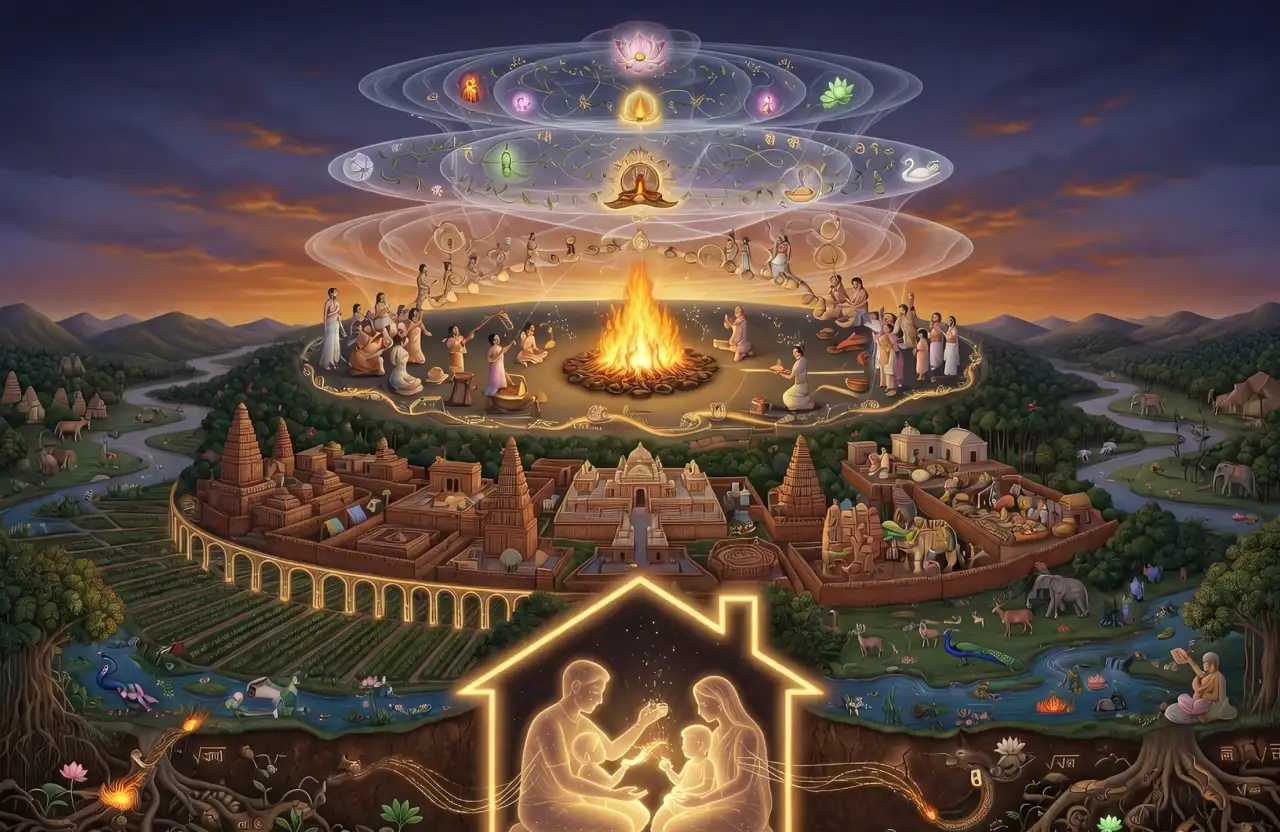
A civilization, broken down to its components, has three layers. The first is the human layer family, lineage, vocational community. The second is hardware settlements, governance, economy, agriculture, military, technology. The third is software social structures, art and architecture, educational systems, religious and cultural architecture, writing and communication. Beneath all of it runs a presupposition rivers, forests, mountains, flora, fauna. The natural world is the precondition on which civilization rests, the substrate without which the entire structure collapses to dust. Indeed, in the language of the ancient Indians, nature is called pra-kriti, the preceding or prior creation one that comes before sanskriti.
Most modern political thought attends obsessively to the hardware layer and neglects the software layer entirely. This is why it keeps producing the same failures. You can engineer an economy and a governance structure from scratch, but if the software layer is corrupt or absent if there is no stable social structure, no coherent cultural framework, no educational system transmitting values across generations the hardware will fail. It will be captured by factions, hollowed out by rent-seeking, and eventually abandoned by the people it was supposed to serve. In an Indic framing, without the necessary controls in place, things are given to dhvamsana, or disintegration. And much like the potter that gently holds the clay in shape, preventing its surrender to centrifugal forces, society must develop mechanisms for avadhvamsana, or the staving off of disintegration. In Panini’s Sanskrit, “avadhvamsana” is the meaning he gives to the root √dhr, from which emerge words such as dharma and dharati.
And what must be done to ensure avadhvamsana? We must begin with the human, work upwards through civilizational software, and treat the hardware as what it is the outer shell of a life lived for deeper purposes.
The Human Layer
Consider how the foundational unit the family is conceptualized when approached through Sanskrit etymology:
Pitṛ, the father, derives from √pā, which means rakṣaṇe protection. The father is no owner, possessor, or patriarch in the Roman sense. The word itself does not support that interpretation. Pitṛ is protector. The husband, too patiḥ carries the same root, the same sense of stewardship. The entire domain of fatherhood in Sanskrit thought begins with responsibility, with stewardship.
Mātṛ, the mother, derives from √mā, meaning pūjāyām worshipping, honoring. The mother is an embodiment to be honored, the term mamatā, the sense of possessive tenderness we call “mine,” captures something the European languages have no good word for the quality of treating another as the self, as inseparable from one’s own being.
Sūnuḥ, the son, derives from √sū, meaning prāṇi-garbha-vimocana bringing forth, begetting. The son is defined by his function he brings forth the next generation. The word encodes duty, and the essential responsibility of ensuring continuity. Recall here the unique human dimension transmission down the generations.
The daughter, duhitṛ, from √duh, meaning prapūraṇa supplementation, replenishment, nourishment. The one who milks, the one who supplements. Also defined through role.
We find from these that the ancient family did not arise through some rigid social theory, or through the male-dominant social structures our ape ancestry gives to us. When the ancient Indians named the fundamental relationships of human life, they did so functionally by what each being does, or ought to do. The family unit, in this conception, is an ensemble of roles each carrying a distinct obligation: protection, selfless honoring, generational continuity, replenishment. And together they ensure the collective unit has what is needed to survive, thrive, prosper, and propagate itself down the time-stream.
This modular identity becomes clearer in parivāra, from pari + √vṛ that which surrounds, encompasses. The family is that which enfolds the individual. And being modular, it is ready for assembly into larger structures.
Kula, Jati, Gotra, Varna Scaling Logic
The scaling logic from family to civilization follows a precise architecture. Kula, from √kul meaning to accumulate it is the organic growth principle of human collectives. A kula accumulates. It accretes, absorbs, expands. A kula is also a shore, a bank the containment structure that gives the river of lineage its course.
Jati, from √jan begetting, being born, arising. At core, jati is precisely natural. It is what one is born into. There is nothing sinister or hierarchical in the root, it is the observation that we do not begin as blank slates in a vacuum but as members of a particular lineage, community, and inherited set of dispositions. The social controversies that have accumulated around jati are about how the concept has been applied and distorted, but they do not severe the etymological reality of what the concept, at root, is.
Gotra the family enclosed by the hurdle, in Monier-Williams’s felicitous phrase extends the lineage principle backward in time to a founding rishi, connecting the living family to a named ancestor in the deep past. The gotra is memory made structural, it carries a founder’s name as a permanent marker of origin. It also introduces a dimension of shared identities vocations or lifestyles. The students of a given guru lived together in his ashram, collectively responsible for the ashram and particularly its hold of go, or cattle. Sharing this responsibility meant one shared the gotra.
Varna, from √varn meaning colouring, exerting, extending the broad colours of human grouping that emerge from the intersection of kula, jati, and gotra. Varna is the large-scale pattern visible when you stand back from the individual family and clan, and look at the whole of a civilization’s human composition. That varna also means “color” is not incidental. Colour is what you see when light passes through a medium. Varna is what civilization looks like when organic human natures pass through individuals.
Modern sensibility makes us parse this taxonomy as imposed hierarchies. In part, this is because modern sociology has no vocabulary for organic classifications of human existence, those without ranked superiority. To analyse human societies, it must find power imbalances and oppressions. But the Indian taxonomy carries normative weight without requiring that any one group be intrinsically superior to another. The confusion arises when the prescriptive is confused with the descriptive and the descriptive is confused with the hierarchical.
If civilization is, as Huntington declared the largest aggregate of humanity that exists, then the above units capture the building blocks of such aggregates. At the most basic level, humans must aggregate in biologically-linked units that are given a deeper purpose and duty. It doesn’t suffice to biologically father a child one must rise to the call of protection and stewardship. On the other side, the privilege of receiving this protection, and the selfless love of a mother, must be honored by fulfilling the duties of propagation and continuity. From here, humans aggregate in various organic ways along channels carved by shared ancestries, vocations, lineages, totems, and more. At higher levels intersecting groupings may emerge qualia that define the “color” of a human’s nature. These channels provide ways for the aggregates to thrive. And when aggregates thrive, which is to say, when they fulfill their intrinsic drives and purposes, they begin to build the hardware of civilization.
The Hardware Layer
The living centers of civilization, in the Indian conception, constitute a scaled set of inhabitation types ranging from the grha to the rashtra. At each level, this scaling carries a coherent philosophy. And most crucially, it possesses a vital teleology ie, it answers what the scaling is for, and what it must achieve.
Grha, the house, from √grh meaning to inhabit, take, acquire is also, in one of its meanings, the body as dwelling of the soul. The poetic overlay, like most aspects of Sanskrit’s multiplicity, is telling. It is the fractal logic of Indian thought made structural. The grha is the physical dwelling of a family, and simultaneously an image of the jiva’s relationship to its body. What is true of the person is true of the household. What is true of the household is true of the village. What is true of the village is true of the desha, and of the rashtra, and so on. We are reminded thus of a critical civilizational mahavakya
Yatha pinde tatha brahmande As in the microcosm, so in the macrocosm.
The settlement typology that follows can get remarkably granular. A grama is an agricultural inhabitation. An Akrimi is a grama where the owners of land and the tillers of land are different the term already carries within it a social observation about land tenure, anticipating a political problem. A ghosha is a pseudosettlement of wandering pastoralists. A vasati is cosmopolitan, abundant with traders from all over. A nagara is a city. A kshetra is cultivated or sacred land. A janapada is a community’s territorial extension. Desha and pradesha are lands with distinct geographical, cultural, and administrative characteristics from √diś, meaning giving, granting, bestowing. The desha is land that bestows.
Then the span rashtra and rajya, both from √raj, meaning diptau shining. Rashtra is the instrument of shining. Rajya is the extent of the shining, the territory within which his stewardship operates. And the raja himself is the bringer of shine. But what do we mean by “shine” or “light” here? Exactly what we mean whenever we use these words in the Indian civilizational context. Light is akin to truth, to knowledge, to prosperity, and even to immortality:
Asato ma sadgamaya, tamaso ma jyotirgamaya, mrityor ma amritam gamaya.
That is the ultimate teleology of dharmic design. To move from untruth to truth, from darkness to light, from ignorance to knowledge, and thus from death to deathlessness. Every institution, every art form, every ritual in dharma ultimately aims for this journey. To enable this journey for the collective, the instrument is the rashtra. And the king, who we appropriately call raja, is the steward responsible for this journey. Notice the microcosm and macrocosm again the raja is to the denizens what the pitr is to the child. And so Shri Rama declared
The king who rules for his people, like a father for his children, earns eternal glory.
So the root of political authority in the Indian conception is no divine contract, nor a sovereign authoritarianism. It is light, the responsibility to illuminate. This is why the qualities ascribed to Shri Rama as the ideal king read as they do humility, knowledge of the scriptures, control of the senses, fortitude, eloquence, compassion, abstention from injury to living beings, responsibility for rivers and forests and sacred sites as part of the rajya’s functioning, the kingdom’s wealth derived only by rightful means. These are the attributes of a light-source. And this is why in Indian civilizational memory, kings are not remembered for the conquests they may have done, or the territories they acquired. They are remembered for how well they upheld raja dharma, the kingly duties.
There is an ecological dimension here too, meriting its own dwelling on. The ideal kingdom must have good crops, plenty of water, sacred sites, wildlife, and water courses independent of rains. The natural world is part of the kingly responsibilities. The forests, the rivers, the wildlife are to be respected and maintained. Environmental responsibility is embedded in the foundational description of what good governance looks like. It reveals an ancient realization prakriti is essential for sanskriti.
The Software Layer
The software layer begins with the questions that have no technical answers what is a human? What is life? What is the social life? How to balance individual impulses with social stability? How to reconcile the irreducible freedom of the jiva with the necessary cohesion of the samuha?
Indian thought addresses these questions through what might be called a multi-dimensional social ontology. We are all born into different conditions jati. We have different qualia, different inherent characters addressed through the varna system as a broad categorical framework. And we have different longings addressed collectively through the ashrama system, which maps shared human developmental stages across a life, and through the purusharthas, which name the four pursuits of human existence dharma, artha, kama, moksha.
The genius of this framework is that it refuses to reduce the human to a single dimension. It does not say that humans are fundamentally rational maximizers and build a civilization around that fiction, as liberal economics does. It does not say that humans are fundamentally class-positioned actors and build a civilization around that fiction, as Marxism does. It says humans are conscious beings with different karmic inheritances, different inherent characters, different developmental stages, and four distinct categories of legitimate aspiration. A civilization that is worthy of the name must create the conditions for each of these to be honored.
Most crucially Indian thought manages social structure over a multiple-life metaphysics.
The karmic path that shapes an individual’s conditions, qualia, and longings transcends the events of a single lifetime. The implications of this are profound. It means that the social position one occupies is a condition to be lived with full dharmic responsibility and transcended, if at all, through the quality of that living. The civilization is designed for the long-term cultivation of consciousness across countless generations. Contrary to popular misunderstandings, this isn’t fatalism but civilizational wisdom. A quality conspicuously absent from any political philosophy premised on the single life.
Together, these ideas form the bulwark against avadhvamsana, ensuring stable transmissions across generations and centuries and millennia. They create an order and tradition that upholds, that sustains. And the word for such a thing is dharma, from √dhr meaning avadhvaṃsane, avasthāne holding, being, existing, living, supporting. Dharma is that which holds. That which staves off disintegration. That which ensures continuance against entropy. It is a quest for harmony, a pursuance of rta the cosmic rhythm within the domain of human creation. A civilization oriented by dharma is one that moves with the grain of reality, rather than against it. Observe the beauty and elegance of Sanskrit once again, as we visit a dharma-rta continuum that rounds up on itself, much like a mandala, and explains the entire cycle of human aggregation and civilization
Rta is motion, rhythm the pulse of reality itself. Within this appears a ripple of thought, of intent a motion in the mind smrta. It is the received wisdom, the transmitted memory of what has worked. But thought must translate to action, intent to instantiation. This takes us to the krta action and creation, movement from mind to manifestation. And what do we ultimately act or create for? For pleasure and prosperity for prta (related to words such as poorti, prema, poorana). From such pursuits, over multiple generations of cultural transmission, emerge best practices that which works. And in turn that is upheld, it becomes the way things are done tradition. Or dhrta, dharma made procedural. In turn this bestows responsibility much like that held by the son and the daughter of continuity. That which we inherit, we must honorably pass along in our turn. It brings us to bhrta bearing forward, nourishing, holding like a vessel does its contents. At this stage, much of the Indian identity is already unlocked. From krta we extend ideas of karma, from dhrta unfolds dharma, and as those who uphold the responsibility of bhrta, we become Bharatas, and our land Bharata.
Done right, it is akin to a civilizational yagya a passing along of the fire of human existence generation upon generation. From a yagya well-done emerges ghee ghrta. From a civilization well managed emerges prosperity for all karmic fulfilments, material satisfactions, proportionate deliverance of artha and kama, and ultimately moksha. But that is over multiple lifetimes, and at the cosmic level over countless yugas, many manvantara cycles. In the interim, as the Puranas declare
annihilation and destruction occur in all ages.
Or mrta the end of things. Death, dissolution. It rounds the cycle up, like the ouroboros snake, for the dharma-rta continuum to start all over again. None of this is vocabulary gameplay. It is a map of civilizational processes over long time-scales which is precisely what they should be. Modern definitions have led us to consider civilization to be a “scaling” problem, ie, of how to grow bigger and bigger, consume more and more, build larger and larger, and so on. But we must take it from a civilization that has managed to exist for thousands of years civilization is a “sustaining” problem, ie of how to persist and continue. In other words of how to ensure avadhvamsana for as long as possible.
We forget this because of anrta the pretender and deceiver. It enters the cycle when the mind begins to pursue its own constructions instead of reality’s rhythms. It is civilization’s most consistent pathology. It is what is unleashed when our smrta, krta, and prta lose their bearing. When intent deviates from the teleology of illumination, when action and creation forget their ultimate role. And it manifests most vividly in that which we are very, very proud of technology.
The Issue of Technology
Technology accelerates the dharma-rta continuum, and compresses both. What once took generations the spread of an idea, the adoption of a practice, the crystallization of a behavior/tradition now takes years or months or weeks. The time available to formulate harmonies between human creation and natural order shrinks with each technological acceleration. The window for the work of aligning human action with reality’s rhythms becomes narrower and narrower.
The modern technological project has no intrinsic orientation toward rta. It does not ask whether its outputs are in consonance with the natural order. It asks whether they are profitable, scalable, and superior. These are questions about the power of human creation relative to other human creations not questions about the relationship between human creation and reality’s grain. A civilization that can only ask the former, and not the latter, is a civilization that has lost its dharma. It has kept the hardware and discarded the software. It is a civilization with shortening lifespan. To be clear our vision is not anti-technological. The dharmic paradigm simply reminds us that yantra, from √yantr, meaning restraint, curbing encodes a relationship between technology and control. A yantra is an instrument of restraint. The technological object is, at its best, an instrument that channels and constrains human action in productive directions. The problem with contemporary technology is that it has lost this character. It has become an instrument of unconstrained amplification a preference for disruption over stability, for unchecked innovation over continuance.
Time and again this is what inhibits a civilization’s continuance. When the materiality and modes of a civilization outpace its original purpose the securing of human prosperity, and cosmic harmony. The civilizational values we can derive from Indic though push against this directly:
- a preference for stability and continuance over disruption (no glory for disruptive innovation, for moving fast and breaking things),
- ecological sensitivity build into the governance structure,
- deep responsibility, and high standards, imposed on the ruling authority,
- the autonomy of smaller human collectives alongside the cohesion of larger structures,
- embedded sustainability, for multiple-life metaphysics means we only briefly inhabit a world that belongs to all, that belongs to the unborn as much as to the living.
So when we say, here at Bodha Research, that our mandate is “to inform core areas of policy with wisdom drawn from Hindu traditions,” we do not speak of a cultural chauvinism, or some kind of religious supremacism. We speak instead of orienting governance, administration, and policy to the right registers of illumination, continuance, sustainability, transmission. We say that policy must root itself to the purusharthas, to raja dharma, for in doing so it calibrates itself towards harmonies. Policy frameworks thus derived would be anchored in an account of what human beings are for what human beings are for, what constitutes their flourishing, what their legitimate aspirations are, what the conditions are for a conscious being to live and die well.
For the raja is a bringer of shine.
The state is an instrument of shine.
Dharma is what holds this pursuit.
Sanskriti is what emerges when the pursuit is well made.
And niti (policy) is how the pursuit is directed.