It is difficult to trace the origin of something you feel like you have always been doing. Anveshi for me is temple-going with friends. And that is something I have been doing for a long time. But humans have a tendency to seek origins. And if I have to seek the origin story of Anveshi it would be the answering of that call to go to a conference in Dhenkanal, Odisha in 2011. I had been working with Makhanlal University at that time and like every other university they were also fond of holding conferences. When they invited me along, I checked the place on the map and it looked tantalizingly near to Puri, Bhubaneswar and Konark, the famous Odisha triangle of some of the greatest temples that Hindus had ever created and I said yes, hoping I will be able to visit them too along with the boring conference. And my hopes regarding visiting temples have always been answered. The gods really smiled at me and I got my first close touch with the wonder that is the Hindu temple.
While every temple in that triangle was an experience, what I remember most vividly was the Sun temple at Konark. We visited it in the morning as the Sun’s first rays were hitting on the walls of the mandapa of the Sun temple and it is a moment I will never forget. My eyes could not stay at one place for the entire complex was just so mesmerizing. Every square metre of the battered walls told stories which would take hours to decode and there were thousands upon thousands of such sculptures. The impression was not just of the finesse of sculpture, but the scale of the imagination, the grandiose of the architecture, the brilliance of the engineering, the depth of the darshana, and the intent of a story-telling tradition so great it turned the most concrete of mediums - stone - a vehicle to transport the most sublime messages that the great Hindu civilization had to give to the world. And this was just the ten percent remains of the once great temple. Konark changed me forever. I was no longer a Hindu warrior fighting to reclaim what was lost; I became the bearer, the carrier of a tradition that was still living. It gave me the ambition of finding out each and every single great Hindu temple ever created by our ancestors, to visit it, document it, study it and to spread its glory to more so that one day we become that civilization once again that keeps creating such wondrous glory wherever it rules.
The journey that inadvertently started that day never ended and still goes on. I started going to every corner of Bharata in search of these great temples and no kshetra of this great land disappointed me. I found these temples everywhere in hundreds and thousands, with variety so greatly mesmerizing that I felt hard at first to absorb it all. But I also found the soul of Sanatana dharma and its darshana woven through all these temples so well that there was no doubt that they were all beads of the same garland. A temple hidden deep amidst the highest peaks of the Spiti valley in Himachal reflecting the same darshana that was displayed in a cosmopolitan temple in Tamil Nadu. Radically different from the outside, yet exuding the same Hindu soul. In this process I have managed to visit more than sixteen hundred ancient temples all over Bharatavarsha over the past fifteen years. And even after all these years and all these temples, I remain that eternally curious student of temple architecture, who starts feeling butterflies in his stomach upon his first gaze at the spire of a great ancient temple. The wonder and the awe has not reduced. It remains as great as ever.
Apart from the extreme satisfaction and inner pleasure that I would feel whenever I was in these temples a desire would arise, the desire to show others the wonder that is the Hindu temple; to bring others to these great kshetras. And this wish of mine got fulfilled at Rashtram Institute, Sonipat when I was asked to create a travel program where I would take a cohort of a few folks to some of these great clusters. We named the program ‘Pathik’ and the first chapter was in Goa. It was a small cohort and yet it started me on the path of what would become Anveshi in future. The experience in Goa told me that the sheer act of taking people to great temple kshetras brings immense change in them. Approached with shraddha the structure comes alive to them, the stones start speaking history, the walls sing devotion, and the very kshetra generates a sense of wonder. But this wondrous excitement then graduates to understanding and commitment if correct guidance is given. That task, difficult but extremely enjoyable, is mine.
When I co-founded Brhat, we continued what I had started as ‘Pathik’ in Rashtram, as ‘Anveshi’ in Brhat. And here the program took new wings. I expanded the scope of my imagination and created itineraries which were very ambitious. The intent was to give the cohort more and more experiences, to expose them to more of the wonderful architecture and sculpture in our temples. We started with Karnataka Anveshi and had such a success that we had to repeat the chapter in two weeks. The experience overwhelmed us all and gave us the conviction that more of this can be done. We then took wings to Odisha, where my own journey had started. Including Shri Jagannatha Dham in the itinerary was a bit ambitious but looking at the reaction of the cohort which got transported to another realm, it was worth it.
I returned to Goa with another cohort, this time, with Anveshi and it was one of our most successful chapters by then, with everyone realizing the spiritual and traditional side of Goa and its wonderful history. The journey then continued with new highs, new chapters and states, traversing Madhya Pradesh in Gwalior chapter, Himachal in Chamba chapter, then mapping the coast of Andhra in Andhra chapter. Anveshi took real wings when we conducted our first chapter in the north-east, in Tripura. We were so overwhelmed with registrations that we had to repeat the chapter in less than two months. We then returned to the mountains to Kumaon in Uttarakhand. Everyone was surprised when we announced Chhattisgarh but I knew that this state will pleasantly shock everyone with the natural and cultural wealth that it has to offer. The next and our latest chapter in Gujarat also told people that there is more to Gujarat than business and entrepreneurship. Every Anveshi chapter was similar and unique at the same time. They were similar in the sense that they were all part of the Hindu temple eco-system where Sanatana darshana and Hindu cosmology made all of them representative of one worldview. They were different in the sense that every chapter had its regional variety in not only the sculpture and architecture but in the kind of eco-system that was built around the temple clusters.
Anveshi taught us in this way that we have the unique opportunity in the world to nurture both unity and diversity at the same time; that Hindu unity does not destroy but nourishes regional diversity; that it is the source of its diversity. The same darshana unfolding in many different ways, with the seed being the same, but manifestation taking the shape of the regional, the local and the timely; thus preserving both the Vedic Sanatana Marga and also nourishing and protecting with Sanatana umbrella, the Desa and all its diversity.
Anveshi taught us the incredible ability of Sanatana dharma to take its core ideas to every nook and corner without brutal centralization. Our temple eco-systems along with our roaming sadhus made sure the core ideas of Sanatana dharma were taken to every last person and this is how a great unity is seen in all the temple kshetras traversed in Anveshi.
Now a new phase of Anveshi is added to what it already is. We are taking new wings and taking to new places in India’s north-east, taking our cohorts to the hitherto unvisited villages to make them witness the traditions and rituals of the last remaining indigenous folks and communities of the north east, and how they preserve traditions along with flowing in one stream with Sanatana dharma.
I am an inveterate traveler as I said and yet I have never found the urge enough to travel outside the country, except to visit temples in other nearby countries. It is because Bharata has to offer so much. Even after going to more than 1600 temples all across this great and blessed land, I am so assured that there are still many more to go to.
This is the spirit of Anveshi too. To keep exploring our own desha more, to keep telling about our sacred kshetras to our next generations.
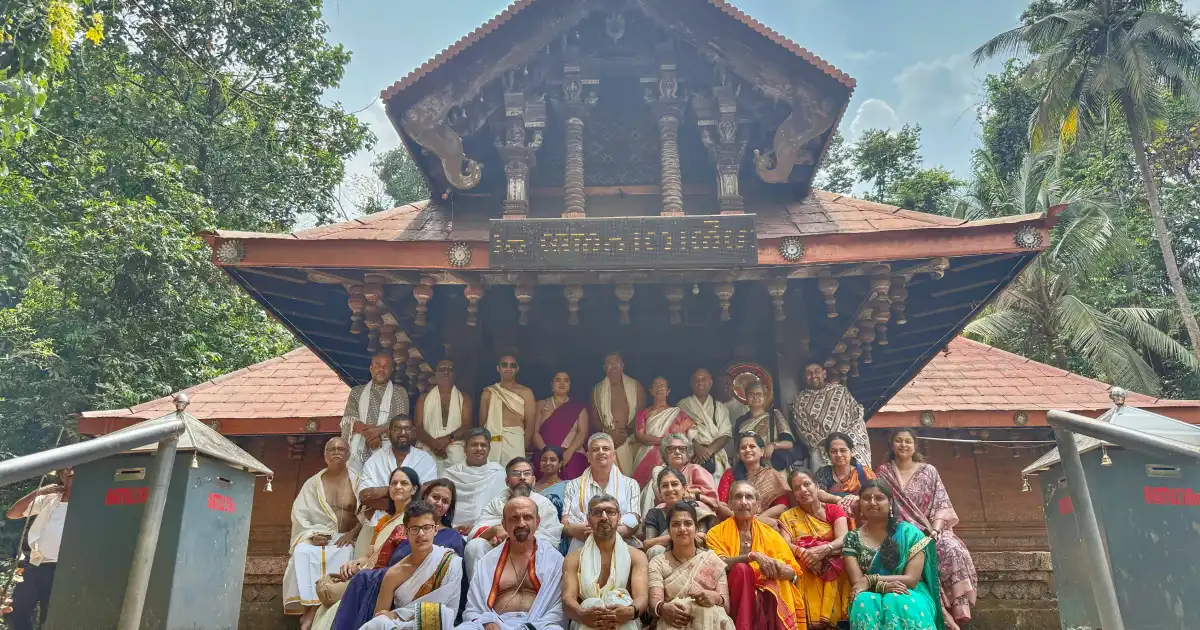
One of the most fulfilling things about Anveshi is its holistic nature where discussions on architecture and sculpture happen in situ but they are not limited to that. For we freewheel into society, philosophy and politics. We discuss the problems of Hindu society, the nature of being Indian, and many other dimensions with all the complexity that comes with it. And this is why Anveshi is prized. And what makes it so easy to have all of this are our Anveshi themselves.
Seldom have I been in the middle of such accomplished and cultured members of our society, all experts in their fields, and yet maintaining the childlike curiosity about our temple heritage, despite knowing about it so much themselves. It is they who add an extra layer to Anveshi making it the experience that is. Before Anveshi I would usually travel alone or with some selected friends and family but now I absolutely love having the cohort with me.
I hope that this journey continues as ever. Dhanyavada.