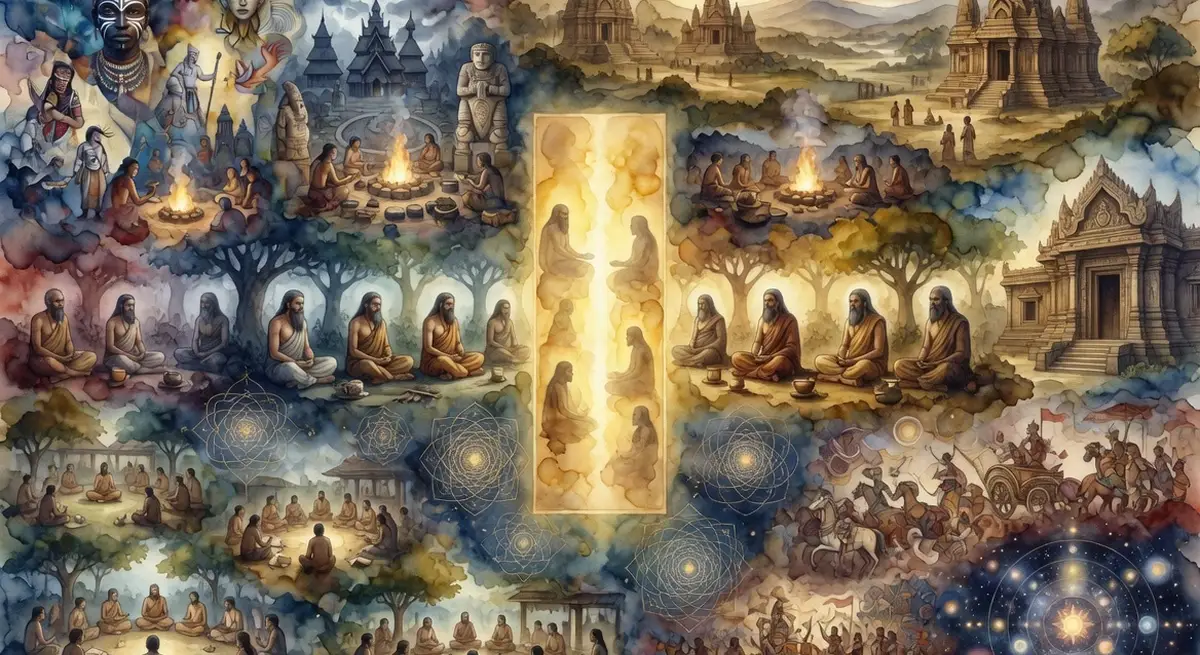
There is an unmistakable kinship among the cultures of the pagan and pre-Abrahamic world. The Yoruba and the Cherokee, the priests of Heliopolis and the seidr-women of pre-Christian Scandinavia, the Aymara of the Andes and the keepers of the Eleusinian rites - all of them recognized that the cosmos was layered, that the visible world was a thin film over a deeper one, that beings of various powers and intentions moved through both, and that the human task was to maintain right relation with the larger field. They had divinities. They had dark entities. They had ancestral lines that had to be honoured. They had ceremonies that did real work. None of them mistook nature for a backdrop. And yet only one of these civilizations developed into a continuous, self-clarifying, multi-layered architecture - one that has survived millennia of pressure without having to be rescued by anybody. Hinduism. Or in its own self-name, sanatana dharma. The rest, with extraordinary partial exceptions, dissolved. They were absorbed, displaced, fragmented, demoted, driven into hiding. Some fragments survive as folk practice, some survive as costume, almost none survive with their cosmology and their epistemology and their social architecture all still working in coherent reciprocity.
Why?
The usual answers describe the result rather than account for it. Hinduism is older. It spread across a vast geography. It absorbed waves of incomers. It produced a written corpus of unmatched scale. But these geographic, demographic, and textual facts are consequences of something. They are not the something. Here, we propose a thesis - in itself not particularly novel. Bharata, and the dharma it carries, were founded by its rishis. From the saptarishis at the cosmogonic horizon, through the rishi-families of the Rigveda, the seers of the Upanishads, the architects of the darshanas, down to figures like Yaska, Panini, Patanjali, Bhartrhari, Shankara, Abhinavagupta, Madhva - and onward in unbroken line - it is the rishi who is the hidden infrastructure. The rishi-function is what made dharma capable of being transmitted, capable of being challenged from inside, capable of regenerating after collapse. Other pagan civilizations had priests. They had shamans. They had bards and oracles and mystics. Bharata had rishis. These are different categories, and the difference is civilizational.
What the Rishi Was
The word itself encodes the answer. Rishi - from √ṛṣ, to rush, to flow, to glow, with a deeper relation, recognized by Yaska in the Nirukta, to √dṛś, to see. The rishi is one through whom something flows, and one who has seen. Both senses are needed at once. The rishi is not a recipient of revelation in the way that the Abrahamic prophet is. He is also not an interpreter of inherited mystery, in the way that an Eleusinian hierophant or an Egyptian priest of Amun was. The rishi is a node in the cosmos through which rta becomes audible. He is the place at which mantra and satya surface, because his consciousness has been disciplined into the right shape. To be fair, this appears to be a strange ontological position. The closest Western analogue is what the Greeks dimly approached with theoria, direct seeing, though with a vastly less developed methodology. Tapas - the deliberate heating of consciousness through restraint and inquiry. Svadhyaya - the recursive study of self and source. Samadhi - the steadying of attention into a field that begins to yield. The rishi is the person who has performed this work and whose perception has consequently widened. It is reproducible. It is teachable. It is open to anyone who undertakes the discipline. A rishi was someone available to rta, and the category was open. Anyone could enter it, and the corpus of those who did was open-ended. This matters because of what follows from it. If revelation is external - given by one God to one prophet at one moment - then the tradition that descends from it must guard the original moment, since no other can occur. If knowledge is acquired through inference alone, then the tradition is only as good as its current dialectic. If knowledge is the direct seeing of an order that is always present, accessible to anyone willing to undertake the work, then the tradition is renewable. New rishis can appear. They have been appearing for as long as the tradition has run. To understand this, we must detail how the rishi stands apart from apparent analogues. Take the priest first. The Hindu purohita is a specialized figure who performs ritual technology, and the priest serves the rishi-tradition rather than constituting it. In Egypt, in Sumer, in much of Mesoamerica, the priestly class was bound to the temple-state. When the state fell, the knowledge died with the institution. There was no parallel category that held the ontology and theology independently of political infrastructure. In Bharata, the rishi sat outside this dependency. The forest-dwelling rishi, the kshatriya-rishi like Vishvamitra, the householder-rishi - these were beyond the temple economy. The temple, when it eventually rose, was downstream of the rishi. The shaman was something different again. The native shamanic traditions of the Americas, of Siberia, of pre-Christian northern Europe, of Africa, produce individuals of immense and confirmed perceptual capacity. Their work is real. Traditionally, the shaman was typically embedded in a tribe and a territory. His knowledge was personal, inherited from a teacher, transmitted in a small lineage, encoded in songs and gestures whose precision depended on a continuous demographic substrate. When the tribe was scattered or destroyed, the lineage broke, and the cosmology with it. The rishi-system was trans-tribal from the start. Vishvamitra and Vasishtha were sought by Bharata, by Puru, by Iksvaku, by Yadu - across the early Aryan polities. The knowledge was not the property of any tribe. It moved. And the prophet was heteronomous. The Abrahamic prophet speaks because he has been spoken to. The rishi sees because he has prepared his sight. The prophet is unique to a covenant, his message is sealed. The rishi is one of an indefinitely large set of seers, past and future, none of whom claim final say. Heteronomy versus svayam-prakasha. The first locks revelation to a moment. The second opens it to recurrence. The bard was a memory-specialist. The Greek aoidos, the Norse skald, the Celtic filid - these preserved memories in metered verse, and were no doubt extraordinary. Their content was largely heroic and historical. But the rishi brought mantra, which is a different kind of object. A mantra is sound that performs. It is acoustic technology, calibrated to what it discloses. The Vedic seers built the entire phonemic order around the requirement that mantra be transmitted without distortion across geological time. No other oral tradition treated phonetic precision as a metaphysical responsibility. The rishi crosses every category the rest of the world uses, and is therefore not contained by any of them. No other civilization developed his analogue, and the absence shows up as a structural difference.
The Architecture They Built
Once you have a category of person whose function is to see and to encode, and once that category is open and regenerable, a particular kind of civilizational architecture becomes possible. The rishis built it. They built the language. Panini finished the work the Rigvedic seers started, building on material that earlier rishis had already analytically organized. The Ashtadhyayi is a generative description from which the entire surface of correct speech can be deduced. Panini’s predecessors had seen the dhatus - the verbal roots from which meaning radiates. He systematized what they had discerned. Yaska before him gave the etymological method, the Nirukta, which treats every word as a frozen action and asks what action. This is rishi-work being done on language itself. The result is a medium in which philosophical and scientific discourse can be conducted with extraordinary precision, because every term carries within it the action it names. It is hard to find a comparable with developed linguistic substrate to this degree of self-consciousness. They built the transmission system. Sruti - what was heard, the Veda - was committed to a memorization architecture so redundant that it has survived thousands of years of geographic and political turbulence with essentially no textual error. Patha modes - jata, ghana, krama - encoded each verse in multiple permutations so that any slip would be detected by cross-checking against the others. This was deliberate engineering. It assumed that copies could be lost, that scribes could fail, that political collapse could occur. It was designed against entropy. They built the darshanas. The six classical schools, plus the Buddhist and Jain darsanas that arose alongside, plus the tantric and bhakti currents. The darshanas are different angles on one terrain. Sankhya and Yoga, Nyaya and Vaisesika, Mimamsa and Vedanta - each a complete philosophical apparatus, with its own logic and its own methodology, addressing different facets of the same field. They argue. They refute each other. They also accept each other’s existence as legitimate. Hindu philosophy is conducted in something like a parliament. No darshana ever achieves monopoly. None tries, in the sense that an Abrahamic theology tries. Each darshana sharpens the others by opposition. The pluralism is structural - a recognition that rta is too large to be exhausted by any single account. Modern liberal tolerance has nothing to do with it. The rishi-tradition built itself with this recognition baked in. They built the lineage system - parampara, gurukula, gotra. Each rishi-family carried its corpus forward through the institution of teacher to qualified student. The qualifications were stringent and the transmission was personal. This produced redundancy. Hundreds of gurukulas, thousands of teachers, tens of thousands of disciples. No single library at Alexandria. No single temple at Karnak. The knowledge was distributed across the subcontinent in a fault-tolerant network. When invasion or famine took out one node, others continued. They built itihasa and purana. The Mahabharata, the Ramayana, the eighteen Mahapuranas and their dependents. These hold the civilization’s memory in narrative form, accessible to those who would not enter the gurukula but who needed nonetheless to live within the dharma. The same metaphysics that the Upanishadic rishis encoded austerely is encoded in Vyasa’s narrative dramaturgy with full emotional reach. A child can take it in. A philosopher can take it in. The same content, two registers, both rishi-made. What the rishis built was a civilization-grade epistemic infrastructure - language, transmission, dialectic, lineage, narrative - within which dharma could be carried forward by people who did not themselves need to be rishis. A tradition that depends on a single institution dies when that institution dies. Egypt is the canonical case. The temple-priesthood was the carrier, and when Egypt was politically broken and religiously overwritten, the whole apparatus went with it. The mythology survives in fragments because its architecture had no redundancy independent of the temple-state. A tradition that depends on a single text dies when interpretation freezes. This is the problem the Abrahamic religions have had to manage by repeated reform movements, with mixed success. The text is fixed, the tradition’s flexibility consists in disputing what the text means. A tradition that depends on demographic continuity dies when the demography is broken. This is what happened to the Native North American traditions, to the Aboriginal Australian traditions, to large parts of pre-Christian Europe. The shamanic teacher-student lineage requires a stable population that can spare specialists. Disrupt the population and the lineage breaks.The rishi-system depended on none of these alone. It had texts, but the texts were re-discoverable through new rishis when seen as such. It had institutions - gurukulas, mathas, akharas - but no single institution was load-bearing. It had demographic depth, but the same depth could be reconstituted from any fragment because the methodology was reproducible. Tapas can be undertaken anywhere. Svadhyaya requires only work and discipline. Samadhi is portable. When the Buddhist universities of the north were destroyed, Hindu philosophy continued in the south and the west. When the temples of the north were broken, the south kept building. When Sanskrit learning was suppressed under colonial education, it was carried in private gurukulas and family transmission. When even those were thinned, individual scholars and yogis carried it forward. When those were thinned further, householders carried fragments, and the fragments were still operational because the architecture of dharma is fractal - the smallest piece contains the structure of the whole. This is anti-fragility in Taleb’s later sense, and it precedes him by several thousand years. Hinduism does more than survive shocks. Under shock it generates new rishis. A civilization without rishis can only conserve. A civilization with rishis can also self-correct. This is what the others lost when they lost their seers, and what they could not regain because they had no method by which seers could re-arise.
The Rishi as a Total Knowledge-Category
There is one more move the rishi-system made that the other pagan civilizations did not. The rishi-category was not restricted to spiritual content. Panini was a rishi. Pingala, who codified prosody, was a rishi. Bhartrhari, who built the philosophy of language, was a rishi. Caraka and Susruta, the medical compilers, are placed within rishi-lineages. Aryabhata and Brahmagupta and Bhaskara, the mathematicians and astronomers, work within an episteme that is rishi-sanctioned. Bharata, the author of the Natyasastra, is a rishi - aesthetics is rishi-knowledge. Kautilya works within statecraft as a rishi-discipline. This is decisive. In Egypt, the priests held cosmology while the scribes held administration and the craftsmen held technology, and these were not unified by a single epistemic claim. In Greece, the philosophers slowly and incompletely tried to unify under reason what the older traditions had held under ritual, the unification was never finished and the ritual side was eventually lost. In Mesoamerica, calendar and sacrifice and statecraft were braided together but no broader integration of knowledge-categories occurred. In the rishi-system, all of it - grammar, prosody, aesthetics, medicine, mathematics, astronomy, polity, metaphysics, devotion, ritual - was understood as the same kind of knowledge, produced by the same kind of work, in continuity with the same source. A single epistemology covered everything from the pinda to the brahmanda. This is why dharma never had to fight science. The two were not competing categories. Both were rishi-work. This is why a Hindu surgeon-rishi like Susruta could perform plastic surgery without it being heterodox, why an astronomer-rishi like Aryabhata could propose rotational and heliocentric hypotheses without being burned, why a grammarian-rishi like Bhartrhari could develop sphota theory without ecclesiastical interference. The integration was at the epistemic root. Other pagan civilizations had isolated geniuses. Bharata had a category that included its geniuses by default. To see the difference, look at what those civilizations could not do. Egypt could not produce its own self-clarifying philosophical lineage. The Hermetica is late, syncretic, partly Greek. The mythology is rich, the metaphysics never received its own systematic articulation in Egyptian terms because the priestly class did not see that as its work, and there was no other class that did. The Native American traditions could not produce their own grammar of ceremony in a textually transmissible form, because their traditions did not include the figure who would do that work and survive demographic collapse. The Greek tradition came closest, with the philosophers, but it lacked a parallel transmission discipline for the experiential side. The Eleusinian and Orphic mysteries dissolved because there was no architecture to carry their interior content forward once the institutions lapsed. The pre-Christian European traditions had bards and druids, and the Roman destruction of Druidic Britain shows what happens when a tradition relies on a single specialist class without redundancy. We do not say this to grade civilizations. The pagan world held knowledge that we, the heirs of the rishis, may not yet have fully understood, and there is much they could teach us. The point is structural. They lacked the category that produces and reproduces seer-knowledge as civilizational architecture, and so when the pressures came they had no mechanism to regenerate themselves. They were mortal in a way that Bharata was not, and is not, because the rishi-function persists. We are in a period in which the rishi-category is under pressure from a particularly modern direction. The colonial over-write tried to domesticate the rishi into the figure of the religious functionary, the temple priest, the caste authority - a much smaller thing, fitting into Abrahamic categories of clergy. Post-independence India absorbed Western academic structures that have no place for the rishi-function and routinely treat it as self-aggrandizing fiction or a quaint hagiographic convention. Even sympathetic accounts often translate rishi as “sage” or “poet,” which is like translating brahman as “God.” Technically not wrong, functionally a destruction. The reason to recover the rishi-category, in our self-understanding and in our institutions, is operational. Nostalgia has nothing to do with it. The civilizational properties Hinduism has - its anti-fragility, its self-correction, its capacity to regenerate after pressure - are direct consequences of the rishi-function. To the extent that the function is supported, those properties remain. To the extent that the function is suppressed - by educational systems that produce technicians instead of seers, by scholarly conventions that pathologize the seer-claim, by economic structures that leave no space for tapas - those properties weaken. The rishis founded Bharata. They produced the linguistic, epistemic, transmissive, and dialectical scaffolding within which dharma could be carried forward by everyone else. They did this and then mostly disappeared into what they had founded - which is itself a rishi move. Their names survived where useful and dissolved where not. The work persists.