
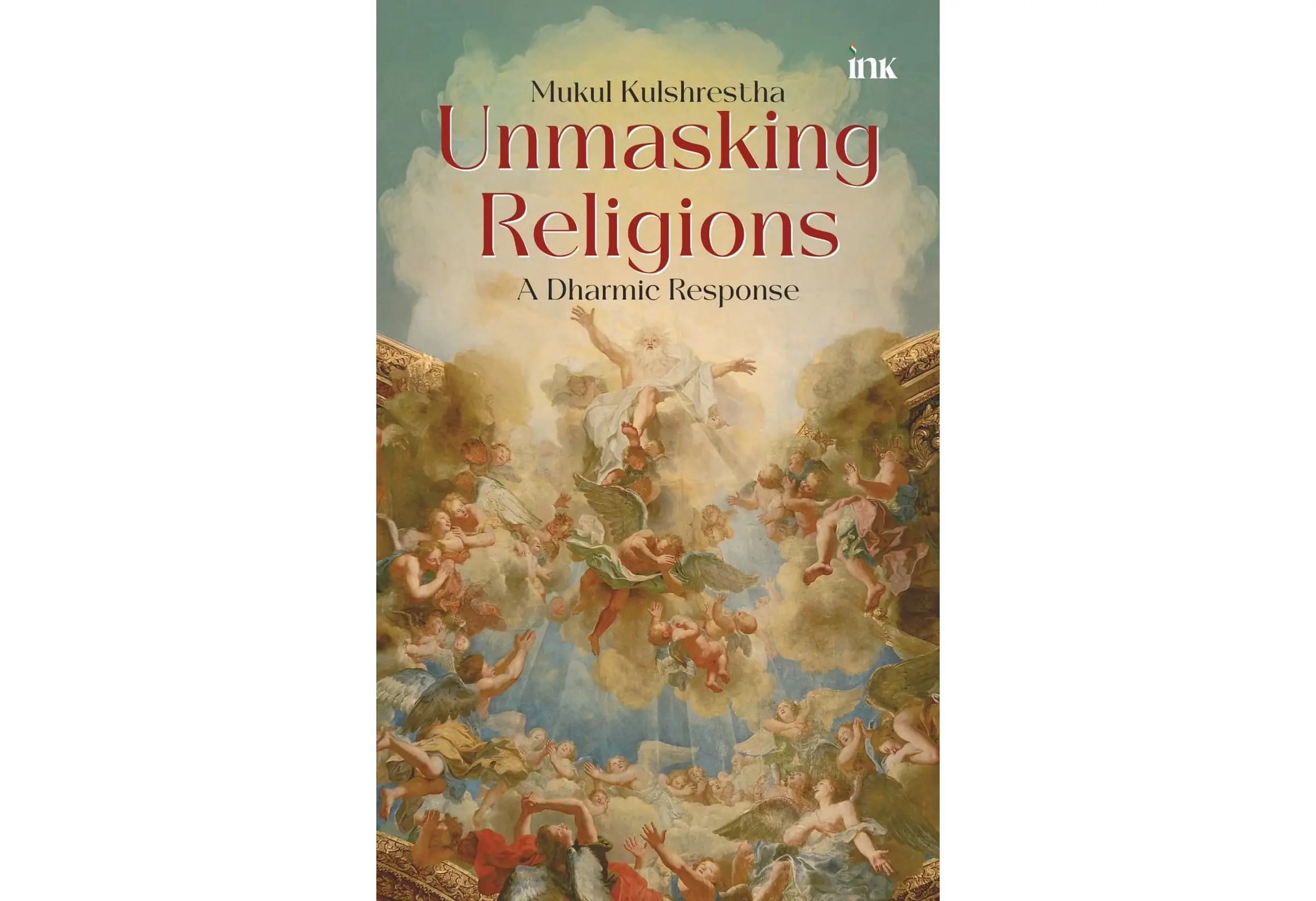
In the current ideological landscape of 21st century, the world is facing a disastrous ecological crisis on one hand, while on the other hand fighting religious radicalism, too. From a philosophical point of view, the book Unmasking Religions: A Dharmic Response by Mukul Kulshreshtha is a serious fundamental interference in contemporary discourse. There has been a tradition of simplification to equate Dharma with religion in today’s academic discourse, and this book is a response to that simplification, from within the Indian knowledge tradition.
The central argument of the author is that Dharma and religion are not only two different sects;but are contrary poles, too, where Dharma is the manifestation of infinity, the natural and nature-centered universal system, while religion is just a product of the human mind, which is a completely historical and artificial creation.
The book highlights the mistake of modern Indian discourse, in which ‘Sarva Dharma Sambhav’ was made the basis of state policies. According to the author, the lack of Viveka has converted this idea into the equating of Dharma with adharma. What is considered Truth is equated with untruth, and that which is the conservator of Nature conservator is seen as one with that which is the destroyer of Nature.
Kulshreshtha has organized his book into three parts, which we will examine here consecutively:
- Part 1: Dharma Vs Religion: Nature-centered-Dharma versus Man-made-Religion
- Part 2: Part 2: The Origin of Religions and the Transformation of the Lord
- Part 3: Religion from the Perspective of Dharma: An Evaluation of Adharma from Dharma’s Point-of-View
Part 1: Dharma Vs Religion: Nature-centered-Dharma versus Man-made-Religion
In the very first part, Kulshreshtha explains the fundamental difference between Dharma and religion. This distinction forms the basis for his thought-process throughout the work. He begins with the concept of viveka in Indian classical tradition, which highlights the capacity to differentiate the long-term return between the virtue of human welfare and mere insights of momentous pleasure. In this part, the author establishes that Dharma is a universal system itself,where creation and creator both are considered One. This perspective represents divinity completely in the appearance of Nature: Earth, rivers, mountains, trees, and animals all are pure and divine, like God, Himself or Herself. Contrary to this, while criticizing the ontology of the Abrahamic religions, Kulshreshtha argues that these religions are completely man-made and man-centered, too. Citing the Bible, he highlights that in religion, God is out-of-nature. There is a duality between creation and creator, and nature is created only for man’s consumption and control.
It is indeed fascinating to follow how the author has explained the fundamental lack in the Abrahamic approach towards Nature, and consequently how the conceptual basis of the environmental crisis emerged from this, in Christian and Islamic scriptures. He starts with a detailed analysis of the dark age of medieval Europe. He denotes how the Church sketched the nature-related Greek Gods as demons or monsters. In the most moving part of this section, Kulshreshtha exposes how Europe’s religion has institutionalized cruelty against animals and trees. He goes through the ample evidence available of persecution and execution of ‘the agents of Satan’: masses of cats, dogs, and many other animals. Not to mention, there were also mass killings of thousands of women under the name of witch-hunting: associate their traditional, herbal knowledge with witchery, and their work with daayan work. The reader comes to understand that the dark age of Europe is just but one era of the most heinous crimes against humanity.
Part 2: The Origin of Religions and the Transformation of the Lord
The second part of this book is the most controversial and intellectually stimulating. In this part, Kulshreshtha investigates the historical emergence and development of the Abrahamic God from linguistic and philosophical perspectives. He evaluates the unique form of God, and also many other forms of divinity, which have permitted violence towards all non-believers. Further, he analyzes how Christianity and Islam established their empires on the same ideological basis. In the Islamic context, he explains how the Prophet Mohammad has stopped all potential improvements by declaring himself as the last Prophet. The author’s examination of the religious legitimacy given to jihad as an ideology, the encouragement for greed and loot in order to gain women in heaven (jannat), exposes how religion politicizes human weaknesses such as lust.
One other distinction between the manifestation of Dharma and religion covered in this section is the dilemma of Body and Conscience. Kulshreshtha notes that Dharma believes in rebirth,meaning that Dharma accepts the immortality of the soul. The body is viewed like a piece of cloth, and this perspective reduces infatuation towards the body. Contrary to this, the religions of the world have forged the concept of resurgence of the body. As a result, there is the existence of superstitions and the fear of death. This also birthed the emergence of burying a body in a cemetery, in order to keep the body preserved.
Finally, Kulshreshtha uncovers the political agenda of Iconoclasm by the Abrahamics. Iconoclasm was a religious duty because it was a violent, political means to maintain the monopoly on Truth by the Church by the Prophet.
Part 3: Religion from the Perspective of Dharma: An Evaluation of Adharma from Dharma’s Point-of-View
In the third part, Kulshreshtha evaluates religions from the perspective of Sanatana Dharma.
He compares an important Dharmic law - Karma, or Cause and Effect - with Abrahamic traditions. The Abrahamic traditions are unable to give any satisfactory answer for natural inequalities. On the other hand, Dharmic tradition perceives that all these inequalities and pain are the result of some cause from a previous time.
Kulshreshtha compares followers of religions with the demons of the Puranas: they destroy Yajnas, and kill priests and Rishis in order to establish their power and authority. They compel others to worship exactly the way they do, the exact historical nature of which can be seen in Christian and Islamic histories. Examples cited in Jihad, Cathode Genocides, and more.
In this final part, Kulshreshtha criticizes the idea of ‘Sarva Dharma Sambhav’. He argues that equating adharma with Dharma has been the biggest ideological mistake of India’s modern saints and politicians.
Dharma is the path of personal and spiritual search for Truth, while Religion is a political, violent, and expansionist thought. That too, it is one which permits fatalistic action and harm against followers of Dharma in the name of blasphemy.
Critical Evaluation and Limitations
From an academic perspective, the power of this book lies in its ideological clarity and multidimensional research methods. Engulfing studies of history, linguistics, classical texts, and ecology, Kulshreshtha’s arguments are thought-provoking, and he provides a serious intellectual challenge to the epistemological authority of Western academic world.
The author’s characterization of the concept of peace in Dharma versus religion is also key.Peace is an integral condition and spiritual matter in Dharma; however, peace is just an impure political condition in religions. That too, peace in religions can only be attained when all non-believers, or Kafirs, and their institutions are destroyed. Although the author, on the basis of his outstanding learnings, has put a serious challenge before Abrahamic epistemology, he lacks contextual inquiry in this book. While criticizing Gandhi’s ‘Sarva Dharma Sambhav’, Kulshreshtha forgets that the Gandhian line of logic, ‘All religions are same,’ was itself a challenge to Abrahamic ego in the well-established colonial environment that claimed the superiority of its own truth over believers of other paths. Rather than crediting this, the author has accepted the most simple and self-convenient explanation of Karma. Even in this, he has not amply explained that caste inequalities are based on a person’s previous life’s karma.
Conclusion
This book beautifully exposes a great mistake of the academic world: simplification in the name of Secularism; and cultural relativism: the habit of considering fundamentally opposite cultures as the same.
The author uses classical texts to demonstrate that in reality, scholars and highly-revered intellectual thinkers equate adharma with Dharma, a great moral and intellectual degradation of India’s Dharma-based civilization.
The intellectual arguments made are clear and deep, which is what makes it an imperative lesson for scholars of Indology, classical texts, philosophy, and environmental morality. This represents a deep intellectual side of Abrahamic religions, from the perspective of pagan and religious traditions.
Finally, this book is subject to academic admiration for its fearless clarity and its depth in research, which reminds us that true spirituality is not only in believing, but it is also in search of Truth and Wisdom.