Islamization of Indonesia
A working compilation on how Hindu Indonesia was Islamized through conquest, suppression of Hindu kingdoms, cultural change, and the survival of Bali.
The transformation of Indonesia from Hindu civilization to Muslim-majority nation was not the peaceful, trade-driven process often portrayed. Historical evidence reveals military conquest of Hindu kingdoms, systematic suppression of Hindu practice, forced flight of populations, and ongoing persecution. As Dang Hyang Nirartha, a Javanese Brahmin sage who fled to Bali in 1489, explained - he “never returned to Java, because Hinduism in Java had been suppressed by Islam.”1
Demak Sultanate’s Campaigns (1475-1548)
Demak waged systematic military campaigns to conquer Hindu territories:
- 1478 - Sacking of Trowulan, Majapahit’s capital2
- 1513 - Majapahit under Prabhu Udara attacks Demak with Balinese allies, but is “driven back”3
- 1518-1527 - Sultan Trenggana’s campaigns conquer “the Hindu-based resistance in Central Java” and “the last Javanese Hindu-Buddhist state”4
- 1527 - Final conquest of Daha (Kediri), ending Majapahit completely5
- Tuban, Pasuruan, Blambangan - All conquered through military force6
The sources explicitly describe Demak “conquering” Hindu territories and defeating Hindu “resistance.” Raden Patah, Demak’s founder, is described as waging war against his own father, the Hindu king, becoming “the avenger of his mother’s wrongs, and rebelling against the authority of his father, defeated him decisively in battle.”2
Banten’s Conquest of Sunda Pajajaran (1526-1579)
West Java’s Hindu Sunda Kingdom fell to Islamic military conquest -
- 1526-1527 - Fatahillah’s forces “easily conquered Cirebon and Banten…even the Hindu Banten ruler converted to Islam.”7
- 1527 - They “seized” Sunda Kelapa (“with violence, even the ruler of that area died in battle.“)7
- 1579 - Final conquest of Pakuan Pajajaran after approximately 15 battles spanning decades.8
Sources note - “From these territories he created the Sultanate of Banten”4 - Hindu territory was conquered and transformed into Islamic sultanate.
Sultan Agung’s “Holy War” Against Blambangan (1636-1640)
Encyclopedia Britannica explicitly describes Sultan Agung’s campaign against the last Hindu kingdom in East Java as a “holy war against infidels.”9 This was conquest justified in explicitly religious terms.
Mass Migration to Bali
The collapse of Majapahit triggered mass Hindu exodus - “A large number of courtiers, artisans, priests, and members of the royalty moved east to the island of Bali.”5
Dang Hyang Nirartha arrived in Bali in 1489 and “never returned to Java, because Hinduism in Java had been suppressed by Islam.”1 He founded major Balinese Brahmin lineages that continue today. This is explicit testimony of religious suppression driving exile.
The sources state - “Hindus of eastern Java, for example, moved to Bali and neighboring small islands”10 and that “Hindus and Buddhists left and concentrated as communities in islands that they could defend.”10
This language of needing to “defend” themselves indicates they were under threat.
The Baduy people of West Java fled when the Sunda Kingdom of Pajajaran fell to the Banten Sultanate in 1579. They retreated to mountain refuges where approximately 11,700 maintain pre-Islamic traditions today.1
The Tengger people - only 600,000 Javanese who remained Hindu - fled to mountains around Mount Bromo. Their legend explicitly describes ancestors fleeing Majapahit’s collapse.11
Scholar Robert W. Hefner noted - “Five centuries after the fall of its last Hindu-Buddhist kingdom, Java retains only one small population that preserves a non-Islamic priestly tradition.”1
What Happened to Those Who Remained?
The sources reveal -
After conquest, “Mahometan Sultans had replaced the Hindu Rajahs throughout all the Insulinde”2
“Mahometanism had become the religion of all the natives of the Archipelago, with the exception of the wild tribes and a few Hindus who had remained true to their faith and taken refuge in the forests and mountains”2
This indicates Hindus who didn’t convert had to flee to remote areas to maintain their faith - classic pattern of religious persecution.
Modern Evidence of Continuing Suppression
The historical suppression continued into modern times:
1954 - Darul Islam militants attacked Sunda Wiwitan base in Kuningan. “They managed to burn our paseban (communal spaces)…They forced our members to convert to Islam”12
1952 - Indonesian Ministry of Religion declared Bali and Hindu areas as “needing a systematic campaign of proselytization to accept Islam”10
1964 - Local government declared Sunda Wiwitan marriages illegal, prompting thousands to flee13
2000-2001 - “Unconfirmed reports that local government officials, largely village heads, were complicit in some of the mass conversions” of Christians who “had been forced to convert”14
2012 - Anti-Shia violence forced Shia community from their homes in Sampang15
2020 - East Indonesia Mujahideen attacked Christian village, killing 4, burning 6 houses and a church, forcing 750 to flee16
Indonesia post-independence officially recognized “only monotheistic religions under pressure from political Islam” and “required an individual to have a religion to gain full Indonesian citizenship rights, and officially Indonesia did not recognize Hindus. It considered Hindus as orang yang belum beragama (people without religion), and as those who must be converted.”10
The Pattern Across the Archipelago
- Aceh - “Sultan Johan Syah…defeated the Hindu and Buddhist Kingdom of Indra Purba” in 1205, establishing Banda Aceh17
- The pattern - “He conquered Daya, and submitted the people to Islam”17
- Ternate (1465-1486): Royal family converted, followed by population18
- Gowa and Luwu in South Sulawesi converted only in 1605 under pressure from Minangkabau missionaries19
The consistent pattern across Indonesia was:
- Coastal ports convert first through trade contact
- Interior kingdoms resist - described as “conflict between the Muslim coast and Hindu-Buddhist inland”17
- Military campaigns conquer interior Hindu kingdoms
- Rulers convert or are replaced by Muslim sultans
- Populations follow over time or face marginalization
- Those refusing must flee to defensible locations (Bali, mountains, remote islands)
As sources note - “This war between the Muslim-coast and Hindu-Buddhist interior also continued long after the fall of the Majapahit by the Demak Sultanate, and the animosity also continues long after both regions had adopted Islam.”17
The “animosity” continuing even after both became Muslim indicates deep trauma from the conquest period. It has been suggested that temple survival suggests tolerance. But the actual pattern is different.
- Borobudur - “abandoned between the 14th-15th centuries” and buried under volcanic ash for 300 years
- Prambanan - Damaged by earthquakes, abandoned
- These temples “were abandoned by Hindus and Buddhists as Islam spread in Java circa 15th to 16th century”20
So they weren’t destroyed because:
- They were already abandoned when Islam consolidated power
- Volcanic eruptions (Mount Merapi 1006 AD) buried many temples before Islamic period20
- By the time of Islamic dominance, these monuments held no active religious significance to challenge
This is fundamentally different from “tolerance.” Abandoned ruins pose no threat to new religious order.
At the same time, there is evidence of religious transformation of sacred spaces -
- Menara Kudus Mosque (1549) incorporated Hindu temple elements - this represents appropriation of sacred Hindu sites, not preservation
- Hindu sacred geography was “uprooted” even where physical structures remained
Compare to India where occupied temples were destroyed - Indonesian temples survived because they were already abandoned by fleeing/converting populations. The dominant scholarly narrative emphasizes -
- “Peaceful” trade-driven conversion
- “Accommodation” and “syncretism”
- Lack of systematic temple destruction
What this obscures -
- Military conquest - Demak’s campaigns, Banten’s wars, Sultan Agung’s “holy war”
- Forced flight - Mass Hindu exodus to Bali, mountain refuges
- Explicit testimony - Brahmin sage stating Hinduism was “suppressed by Islam”
- The necessity of refuge - Hindus concentrating in “islands that they could defend”
- Survival only in remote areas - Mountains, one island (Bali)
The Middle East Institute claims - Indonesian Islamization was “the outcome of a lengthy and peaceful Islamization process.”21 This is contradicted by -
- Documented military campaigns
- Explicit descriptions of conquest
- Hindu populations fleeing for their lives
- Contemporary testimony of “suppression”
- Survival only in defensible refuges
Indonesian scholarship’s claim - “Islam entered Southeast Asia through trade channels…so that no violence or coercion is found”22 This is demonstrably false based on -
- Military campaigns against Majapahit (1478-1527)
- Conquest of Sunda with ruler dying in battle (1527)
- Sultan Agung’s “holy war” (1636-1640)
- Forced conversions documented in modern era (1954, 2000-2001)
The traditional narrative credits nine Muslim saints (Wali Songo) with peaceful Javanese conversion through cultural adaptation. M.C. Ricklefs noted from academic research - “no reliable pre-18th-century documents substantiate the saints’ individual existences or coordinated roles.”23
This is retrospective myth-making to create a peaceful conversion narrative. The actual contemporary evidence shows military conquest.
Bali remained Hindu not through Islamic “tolerance” but through -
- Geographic isolation - Island separated by water
- Strong Hindu kingdoms - Organized military resistance
- Strategic buffer - Maintained Blambangan as buffer state
- Successful military defense - Repelled Mataram invasions (1670s-1680s)1
- Dutch intervention - Colonial power prevented further Islamic expansion
Bali’s survival proves that where Hindus had military capability and geographic defensibility, Islamization did not occur. This indicates that Java’s Islamization involved power dynamics and force, not simply persuasion. The suppression continued after 1945 -
- 1952 - Government campaign to convert Hindus to Islam10
- 1954 - Darul Islam forced conversions12
- 1964 - Sunda Wiwitan marriages declared illegal13
- 1965 - Estimated 100,000 Balinese killed in anti-communist purges1
- 2006 - Regulation allowing intimidation to shut down “illegal” churches and Hindu temples13
- 1,500-2,200 churches closed (2006-present)13
- 2019 - North Lombok stopped Hindu temple construction to “maintain peace and order”24
Hindus must declare themselves under “Hinduism” category to be recognized, and the state only recognizes six religions. Indigenous Hindu practices are forced to align with either Islam, Christianity, or redefine themselves as “Hindu” even when their traditions differ. As one adherent stated - “Systematically, [I was] forced to choose a religion.”16
The evidence demonstrates Indonesian Islamization involved -
Military Conquest:
- Systematic campaigns against Hindu kingdoms (1478-1640)
- Explicit “holy war” terminology
- Rulers dying in battle defending Hindu kingdoms
- “Conquering Hindu-based resistance”
Forced Displacement:
- Mass exodus to Bali
- Flight to mountain refuges (Tengger, Baduy)
- Explicit testimony: fled because Hinduism was “suppressed”
- Survival only in “islands they could defend”
Religious Suppression:
- Contemporary testimony of “suppression”
- Hindus needing to “take refuge in forests and mountains”
- Modern forced conversions (documented 1954, 2000-2001)
- Government campaigns to convert Hindus (1952)
- Legal marginalization of Hindu practice
Cultural Destruction:
- “Uprooting of Hindu sacred geography”
- Loss of Sanskrit texts (preserved only in Bali)
- Appropriation of temple materials for mosques
- End of Hindu temple patronage
- Hindu literacy and scholarship centered only in Bali
The “peaceful trade-driven conversion” narrative serves to whitewash this history. The actual pattern matches religious conquest elsewhere - military defeat of existing kingdoms, suppression of the defeated religion, survival only in refuges, and ongoing persecution of remnant communities.
Java’s Hindu civilization did not “peacefully evolve” into Islamic civilization. It was conquered, suppressed, and driven into exile, surviving only where geography and military power made it defensible. The testimony of those who lived through it - like Dang Hyang Nirartha who fled because “Hinduism in Java had been suppressed by Islam” - tells the true story.
Endnotes
- Balinese and Hindus in Indonesia
- Indonesia History - Sultanate of Demak
- Majapahit Kingdom
- Demak Sultanate
- Majapahit
- Demak Sultanate
- Demak Sultanate: The Fortress of Islamic Greatness in the Middle Ages Java Island
- Sunda Kingdom
- Agung
- Hinduism in Indonesia
- Tenggerese people
- Religious Minorities in Indonesia Face Discrimination
- Religious Intolerance, Discriminatory Regulations Against Minorities in Indonesia
- Indonesia International Religious Freedom Report 2003
- 2021 Report on International Religious Freedom: Indonesia
- In Indonesia, a Rising Tide of Religious Intolerance
- Spread of Islam in Indonesia
- Ternate Sultanate
- Sultanate of Gowa
- List of Hindu temples in Indonesia
- Religious Pluralism versus Intolerance: Sectarian Violence in Indonesia
- The History Of Islamization In Indonesia: Its Dynamics And Development
- Islamization in Southeast Asia
- Dozens of Houses of Worship Closed, Vandalized in Indonesia: Rights Commission
Appendix
The following is sourced from X, via the handle @Ofer_binshtok:
This myth is not merely a historical error; it is a deliberate, sophisticated, and dangerous fabrication that continues to serve global Islamist propaganda and a fearful Western academia. It appears in Indonesian textbooks, UNESCO reports, YouTube videos, and social media platforms.
The Truth: Islam became the dominant religion in the archipelago through a forceful, violent, and bloody process across three distinct stages, exactly as it did in Persia, India, Spain, Egypt, and Africa. The violence did not end in the 17th century; it continues through December 2025.
Phase 1:
Structural Economic and Racist Violence – Monopoly as a Strategic Weapon (13th–17th Centuries)
The Muslim traders who arrived in the archipelago were not innocent merchants. They were the arm of a global economic system with distinct racist and religious characteristics. The mechanism was simple, efficient, and brutal.
The Monopoly: All globally significant trade, including spices, silk, and pepper, passed through a hermetically sealed Muslim trade network.
The Privilege: A Muslim trader received military protection, interest-free credit (permitted only between Muslims), access to safe ports, and the license to attack non-Muslim ships as legitimate spoils of war.
The Extortion: A non-Muslim trader faced total boycott, heavy taxation, abandoned ports, and economic collapse.
The Scholar’s Testimony: Prof. Anthony Reid (Southeast Asia in the Age of Commerce, Yale 1993) explicitly writes that the Islamic diaspora created a “closed economic sphere” in which non-Muslims were reduced to second-class subjects. Conversion was not a spiritual choice but an economic necessity for survival.
Examples:
Malacca (1414): The Hindu King Parameswara converted only after Muslim traders boycotted his port. Immediately following his conversion, the city became a superpower.
Aceh: The sultanate enforced Sharia laws on trade and levied special taxes on non-Muslims.
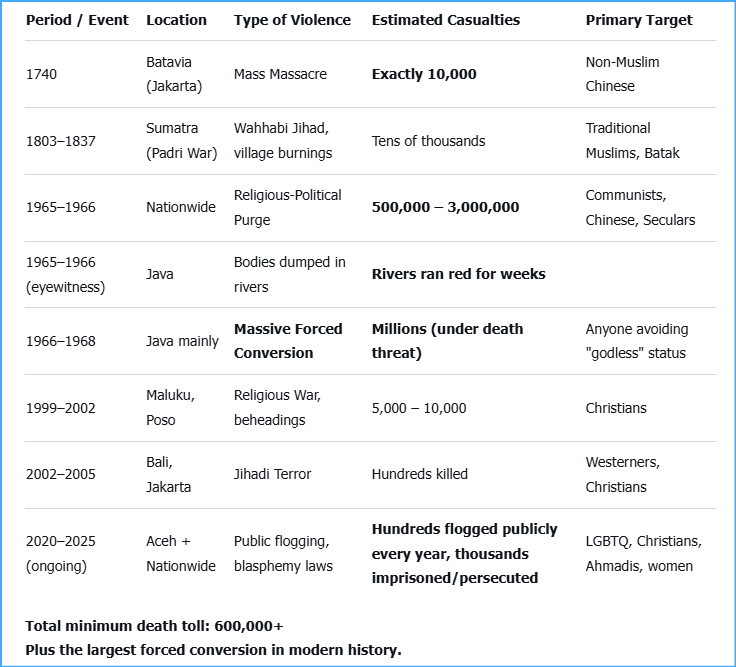
The Chinese: They were pushed to the margins until they either converted via economic coercion or were massacred. Approximately 10,000 were murdered in 1740.
Phase 2:
Direct Military Violence – Jihad and Conquest (15th–17th Centuries)
Once established on the coast, Muslim forces shifted to the military conquest of the interior.
The Fall of Majapahit: The great Hindu empire did not collapse on its own. The Sultanate of Demak conquered it militarily. The capital was burned, and the King was killed or forced to flee.
Aceh’s Jihad: This involved the violent conquest of the Pasai, Daya, and Pidie kingdoms.
Conquest of Sunda (1579): The kingdom was destroyed in the Battle of Pajajaran.
The Research: Scholar Santosa (2016) defines these events as violent and bloody occurrences during the Islamization of Java.
Phase 3:
The Recurring Internal Pattern – Jihad against “Moderate” Muslims (1803–1837)
During the Padri War in Sumatra, Wahhabis returning from Mecca declared Jihad on their own people who were deemed not “pure” enough.
Their actions included: Burning of entire villages.
Massacre of the Batak tribes, including the murder of men and the enslavement of women.
Forced hijab and brutal circumcision.
Phase 4:
The 20th Century – The Largest Forced Religious Conversion in Modern History (1965–1968)
This is the critical phase that explains the current demographics of the nation.
The Massacre (1965–1966): Between 500,000 and 1,000,000 (with estimates reaching up to 3 million) people were murdered in an anti-Communist purge led by Muslim militias (NU/Ansor) under Jihad fatwas against “atheists.” Eyewitnesses reported that rivers in Java ran red with blood for weeks.
The Forced Conversions (1966–1968): This is the most silenced point. Millions of Indonesians officially converted to Islam during these years simply to avoid being murdered as “godless.”
This constitutes the single largest act of forced religious conversion in the 20th century.
Phase 5:
The Late 20th & 21st Centuries – The Jihad Continues (1998–2025)
1999–2002 (Maluku and Poso): Events included the massacre of Christians, burning churches with people inside, and the beheading of Christian schoolgirls (Noorhaidi Hasan, 2006).
2020–2025 (The Present):
Aceh: Public punishment via caning is administered to LGBTQ individuals, women, and unmarried couples.
Blasphemy Laws: These laws are used for the legal persecution of religious minorities such as Ahmadis, Shias, and Christians.
Terrorism: Attacks continue against churches and Western targets.
Conclusion: The myth is dead. We have buried it along with all the blood, money, and fear it concealed for centuries. Islam in Indonesia did not spread peacefully; it conquered.
Summary Table: The Scale of Islamic Violence in Indonesia: