My story of travel is something completely opposite to someone like Paul Theroux. It was love at first sight. Love - with the thought of the freedom that travel would allow; with the thought of the expanding horizon; with the places that I went to; and with the sheer experience of travel itself. Odisha takes the cake as the first state that I fell in love with, but Kerala was not behind and not far in how much of my heart it claimed. It was December of 2011, when I first visited it for a grand trip of around eighteen days and it never left me the same.
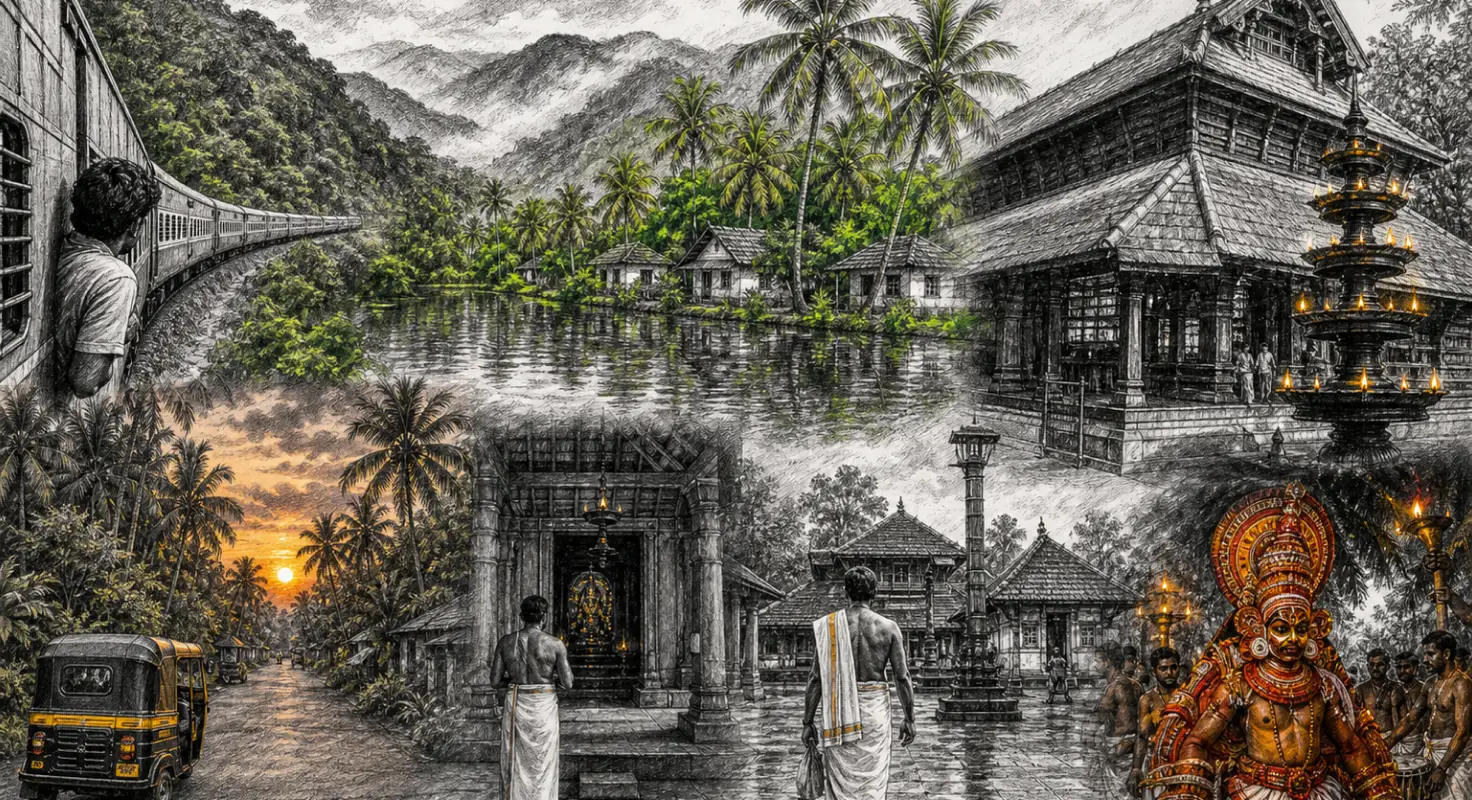
I specifically remember the morning when our train crossed the Palakkad gap and emerged onto the other side of the Western Ghats. It was like passing through a secret fantasy gate. The entire atmosphere almost transfers instantly once your train passes the Palakkad gap: the lush green surroundings that most north Indians don’t dream of in summers; the beautiful houses amidst coconut groves; beautiful ponds which accompanied almost every structure; and the gray sky which was almost always overcast. The train slows down almost consciously to respect the locals who live a stone throw away from the tracks and to let the travelers with wanderlust soak in the wonder that is: Keralam.
I was never the same after that. The land of lush green landscapes, perpetual rains, beautiful beaches, wonderful food, and most of all the most wonderfully alien yet familiar temples of Kerala made me a perpetual fanboy of Kerala. These temples exuded ancient. Not just the structure and the devata, but everything inside them felt as if transported from an ancient world. And yet they were as living as any structure can be. Frequented by the locals daily. Full of rituals which kept those places alive in the real sense of the term.
And for the first time I just stumbled upon such a beauty, the amazing Peruvanam Shiva temple in Thrissur district, near Irinjalkuda, where I had been staying with my friends. An evening walk through narrow busy highways, overladen with coconut and other trees, while the Sun set on one or another grove, was something which in itself was an amazing experience. Imagine stumbling upon an almost thousand years old Kerala temple in wood, excellently preserved, moving in its quiet rhythm with almost no one around. I read the plaque in absolute quiet and then proceeded inside the temple. The experience of removing all your upper garments was still new to me and the exotica that it lent to the process was something which made any visit to a Kerala temple special and a memory to which I would go back to again and again in life. You were stripped to an attire which added to the ancientness of the act of temple going.
Enter any Kerala temple even today and the scene inside is almost the same as it would have been hundreds of years ago, and for that alone I can go along with the process.
I did not know it back then, but I would keep coming back to relive this memory of visiting a Kerala temple again and again in the next decade: the square or rectangular prakaram outside, the separate free standing mandapam inside, the dark and dingy ceilings where faint images of ancient murals stare at you if you linger enough; and then the narrow space where devotees gather in front of the attached mandapam; and then the sight of the devata, deep inside the garbha-griha, often discernible only through his ornaments and lit only through the non-electric lights. The certain way in which you go around pradakshina and bow at all the subsidiary shrines. Coming out of the temple you put on your upper garments again and carefully collect the prasadam inside your bag.
It took me five years to come back to Kerala but then the series started and I would do many temple runs dedicated only to the beautiful temple clusters of this great land. Thrissur, Kottayam, Kozhikode, Kasargod, Mallapuram and Kannur. Each trip would follow a very predictable pattern I would look forward to. Checking into a hotel in quite contemporary clothes, and then getting out for a temple run in veshti and anga vastram. The rides in taxis were also there, but it was the rides in the Kerala autos which showed me the place most beautifully. No AC and full breeze that hit you in an auto meant your traditional attire was not out of place and you felt completely comfortable naturally and culturally in that. Getting up before dawn and reaching the first temple when the rays of the morning Sun would just start hitting you is something nobody ever forgets.
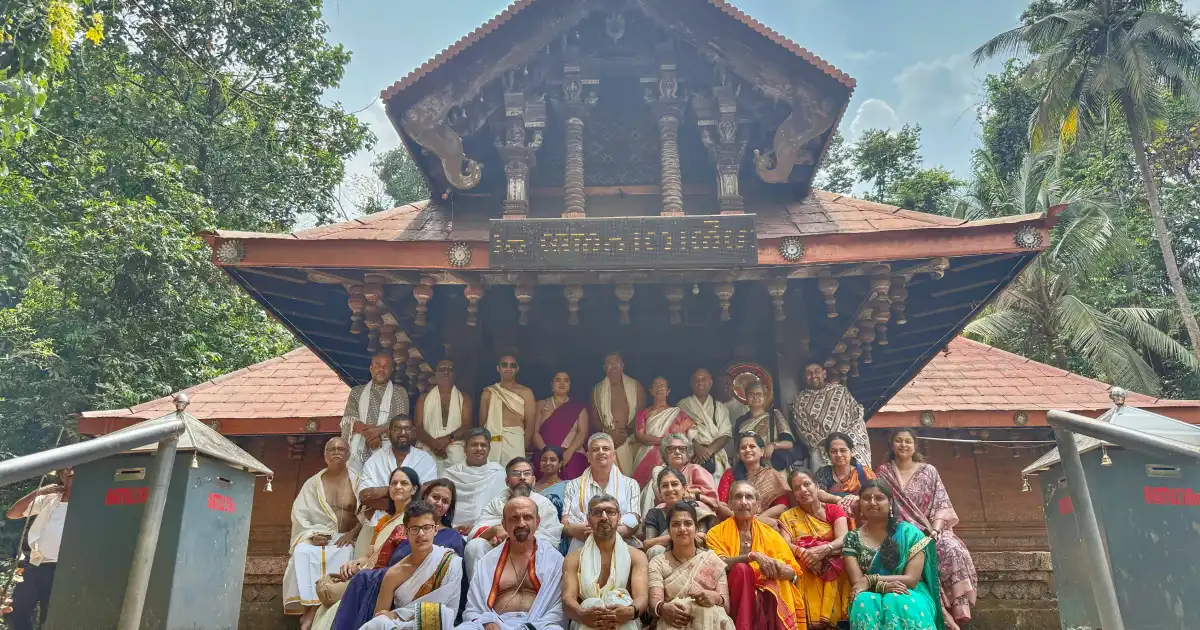
By the time I did a temple run in the temples of Kannur I was already leading the Anveshi program and the thought of introducing my cohort to the beautiful temples of Kerala in a cluster hidden away in the Islam dense north Kerala was a thought I couldn’t let go of. And so we declared the Bodha Anveshi chapter. And it was an experience which we always cherished. We stayed in a place just a stone throw away from the Kannur airport. Apart from being convenient the place was very conducive to the kind of yatra we were having.
Kannur is the epicenter of ancient temples, continuing ancient practices. And it is a complete repository of the Hindu pantheon. From temples dedicated to Shiva, Vishnu, Rama, Krishna, Hanuman, Parvati, Ganapati, Subramanya and Annapoorneshvari we went from one experience to another. Contrary to what leftists and anti-Hindus would have us believe Kerala vibrates with the worship of Shri Rama and the valor of Shri Hanuman as we witnessed in two temples. What was most intriguing was how the temple legends connected with each other. That’s how Rajarajeshwari visited her husband, Lord Shiva in another temple a few kilometers away. How the bhoga to one deity could also be offered and would actually be offered to another. How the rhythms of the year would rise and fall and how devatas would change place in summers and winters and in the rainy season. Like us, they would travel, maintain relationships, have historical memories and would honor old friends.
In one place Shri Krishna and Balarama would reenact their childhood for their That this went on in the realm of deities, was the part which was most endearing. Here the fact that the deities were not concepts but divinities, as alive with gunas and memory, as any living being, was very palpable. This bhava was natural to the temple goers and for them there was nothing symbolic in it. It was a fact. And they followed it. This was something which the Bodha Anveshi cohort observed very closely. Not only the dress code but the way in which a temple is visited; why it is closed at a particular period of time; when does the palki of devata get out at other periods.
We saw temples in their natural and cultural eco-systems. We saw deities and kshetras interacting naturally through eco-systems and narratively through sacred cosmologies. In this wide tantra deities marry each other; visit each other’s places at night or day; take the prasadam offered to the other; protect the realms they rule and solve the problems of their subjects through deva prashna during Theyyam. In one of the most divinely surreal spectacles of all of Anveshis put together, we witnessed the sacred dance of the gods in a night long performance of Theyyam.
We, the Anveshis, witnessed how the sacred heart of Kerala beats so vibrantly in Kannur, despite all that has happened.
Kerala is really god’s own country but seldom do people witness the beauty that its culture exudes through its sacred kshetras, especially in a region like Kannur which is sandwiched in some of the most rabidly Islamist regions of India, where Muslim League is still active and wins. Yet this sacred heart of Kannur still vibrates with divine kshetras. But if we want this side of Keralam to survive and thrive, we need Sanatana dharma to roll back and reabsorb the individuals and communities lost to the barbarian ideologies of monotheism.
Read more about the Kannur Chapter of Bodha Anveshi.