I can never forget the day when I was first told by a Himachali, that they don’t just worship their gods, they talk to them. There was no hint of irony in his voice, no sense of sarcasm. He was speaking without even an iota of doubt that somebody would fail to understand what he was saying. It was that real for him, and ever since then I have met many Himachalis who say the same. The devatas are not mere concepts for them, lofty intellectual concepts to be cherished for anthropological reasons. No. For them, devatas are as, or even more real than us, human beings, and that is how they are treated.
At that time I had no idea that one day I would have the privilege of introducing many others to these divine experiences through the sacred temple tours that I now lead as Bodha Anveshi. In the summer of 2026 we took a cohort of 25 folks to the Kullu chapter of Bodha Anveshi and experienced the deep divinity of the pahadi folks up close.
We started with two of the guardian goddesses of the great Himalayas, the Manasa Devi near Panchkula and the Naina Devi who sits right where the hills start with a steep elevation. These temples which came up later in history but which have become great centers of devotion for Hindus show how our tradition continuously adapts. The threat to these hills that came from the Khyber pass in the West reached the foothills soon and just in time a ring of great goddess temples started coming up in this region which later made the circuit of Nava Durgas. Even today it feels as if the goddesses stand looking towards the plains protecting the sacred hills from the invaders. And in the next few days we saw what was there inside those hills.
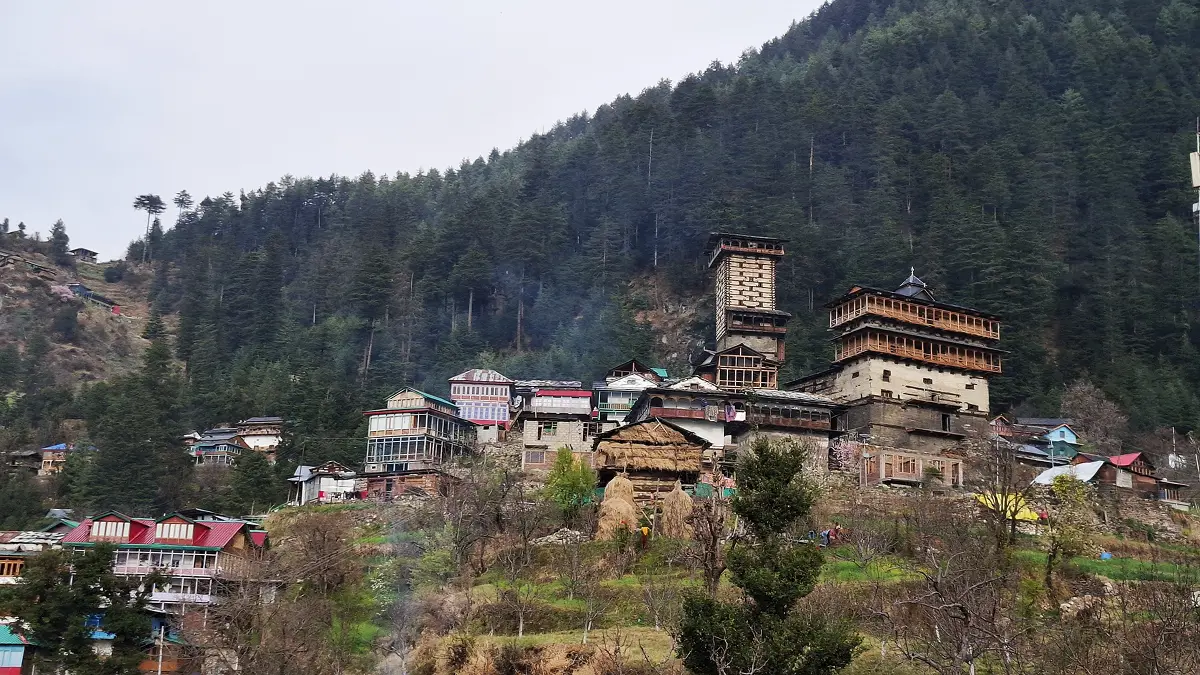
The two kilometre steep trek inside the Great Himalayan National Park to the Jogini temple in Chehni Kothi was one of the greatest adventures that Anveshis ever had. The trek itself was not just steep and difficult but was extremely rewarding. The Shringa Rishi temple on the way was a great reward. How the story of the Ramayana has reached every single corner of Bharatavarsha was proved by the visit to this temple. But by the time the cohort reached the top it was in a different zone after the physical labor that it took to reach there. There are two temples in this breathtakingly beautiful village alongside the great deodars that have been standing here for centuries. One is dedicated to Shri Krishna which is open to all and the other is Jogini temple which is closed to most outsiders and open to the locals only at festivals and during special pujas. But we were in luck and the temple was opened to us though to reach the top of this temple was a feat. It is the tallest temple in the Himalayas and is of a height of 150 ft. Two thirds of it is a solid square tower built in kath kuni style and the top most floor only has the temple. The outside stairs are very narrow and are carved out from a single deodar trunk. The angle is steep and there is no railing. The sanctum is unlike most temples I have ever visited. The goddess is represented by the metal masks. The sanctum lets in light from all sides and creates an atmosphere like there is none.
In the evening we could witness the Sacha Jach festival at Sesha Naga temple in Jibhi, where we saw how devatas jump on the shoulders of their devotees. There is scarcely a feeling like this. Entire town was involved in it. Every home, every person was there at one place, organizing and enjoying the festival at the same time. A ring of local young boys guarded the troupe with the devata palki and this ring would throw out of its path!
The cohort went through the valley temples of Bajaura, where the false sarvatobhadra temple dedicated to Shiva called Basaveshvaara exists and it is the most beautiful temple ever built in Himachal in nagara idiom. The Brahma temple of Khokhand proved that Brahma temples exist even outside Pushkar. It is built in the pahadi idiom of wooden receding pagodas. The setting of the temple is even more picturesque, in a quaint Himalayan village.
The Hidimba temple of Manali is world famous but yet the first visit overwhelms the visitor. It is not just the sheer scale, but the sacred environs which are created by the protected forest around it, create a wonderful effect. While Vashishtha sports three temples related to Ramayana at one place, it is the temples of Naggar which showcase the Himchali temples in its most breathtaking variety, the nagar style Gourishankara temple and others, the Himachali style completely wooden, Tripura Sundari temple and the hybrid Krishna temple. A peculiar temple exists inside the Naggar castle where 33 gods are worshipped at one flat stone, which is supposed to have been flown here by the flying deities in this valley of gods.
Himachal is a place where gods talk to human, where rishis are worshipped as much as deities, where gods travel to other temples to visit other gods, where hundreds of gods are worshipped in one temple in uniconic form, where Mahabharata and Ramayana come alive and where a pristine Hindu life can be seen.
Eager to take another cohort in Bodha Anveshi. Come to Badami, or Odisha. Registrations open now.