

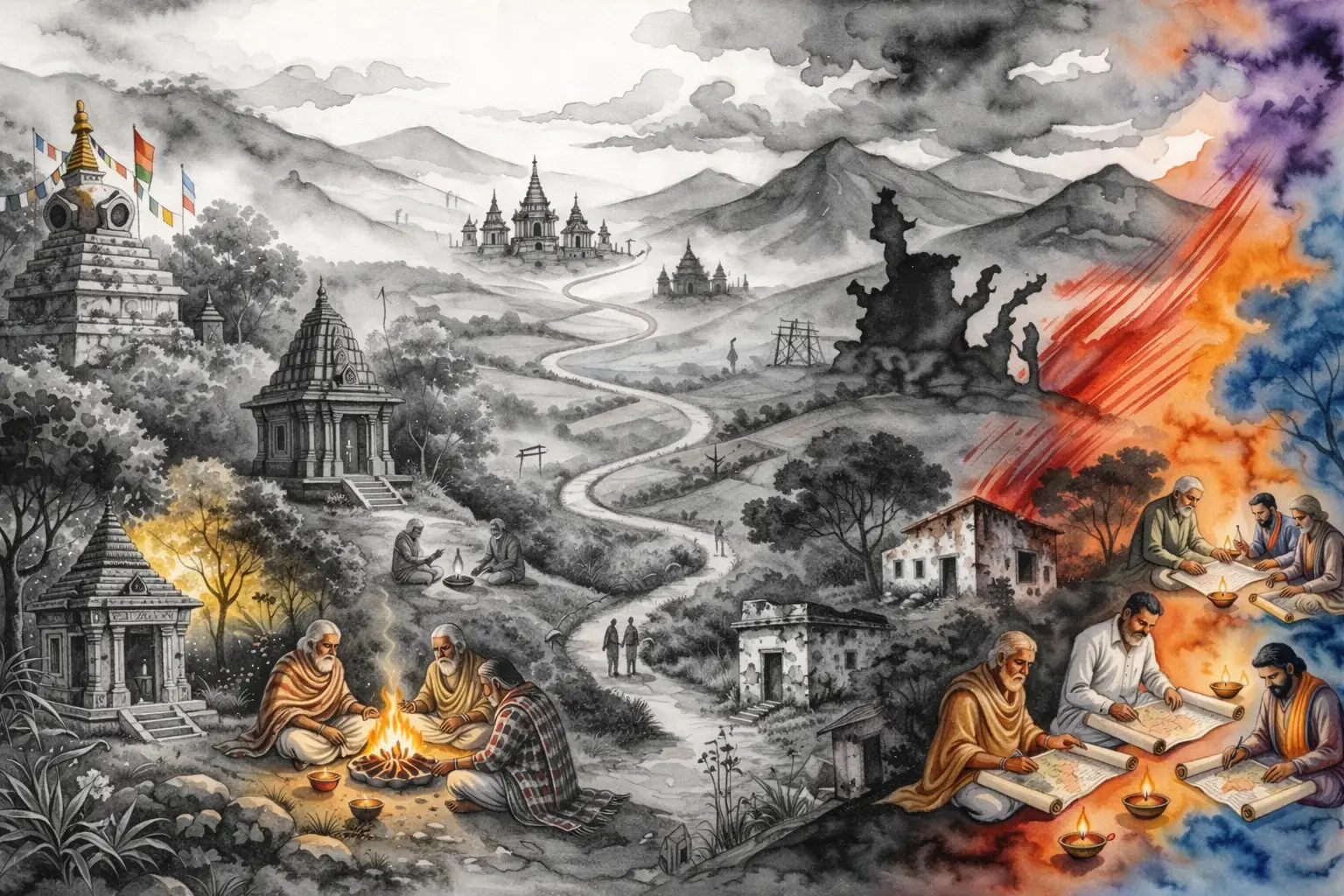
The North East of India has long been a conduit for connecting India to the rest of the world on its East, having a distinct dharmic culture of its own. The Northeast as it is commonly known, is home to some of the most distinctive tribal cultures in the world. Although distinct in nature, their customs and traditions are inextricably linked to that of the rest of India, and strongly represent the diversity part of the famous axiom: ‘Unity in Diversity’, that marks India’s identity. Bauddha dharma, Vaishnava dharma, Shakta and many other indigenous religious-traditions have characterized NE India for centuries.
This area, known for its lush landscapes and rich cultural heritage, has historically been a bridge between India and Southeast Asia. This region, due to its inaccessibility caused by geography and myopic political decisions, faces an identity crisis of enormous proportions due to the large scale conversions and demographic change. With the advent of missionaries and subservient political power, NE India was converted and culturally divorced from the rest of India.
This factor also leads to clash of ideologies on the civilizational level with unmitigated violence, few glaring examples of which are the longest running insurgency movement of independent India. This, coupled with the geographical isolation created by the huge chunk of no go landmass in the form of Bangladesh in between has provided a field day for anti-India agents to rule the roost. Therefore, it becomes necessary to counter the rising tide of hostility as dharmikas and reverse the wave of conversion and cultural alienation among residents of NE India. To achieve this purpose, a rigorous and detailed study of the religious and civilizational trajectory of the region needs to be undertaken, and strategies formulated to arrest and reverse the growth of imperialist ideologies. By documentation and wide dissemination, the cultural matrix of Bhārata may be preserved and its geographical frontiers made more secure.