

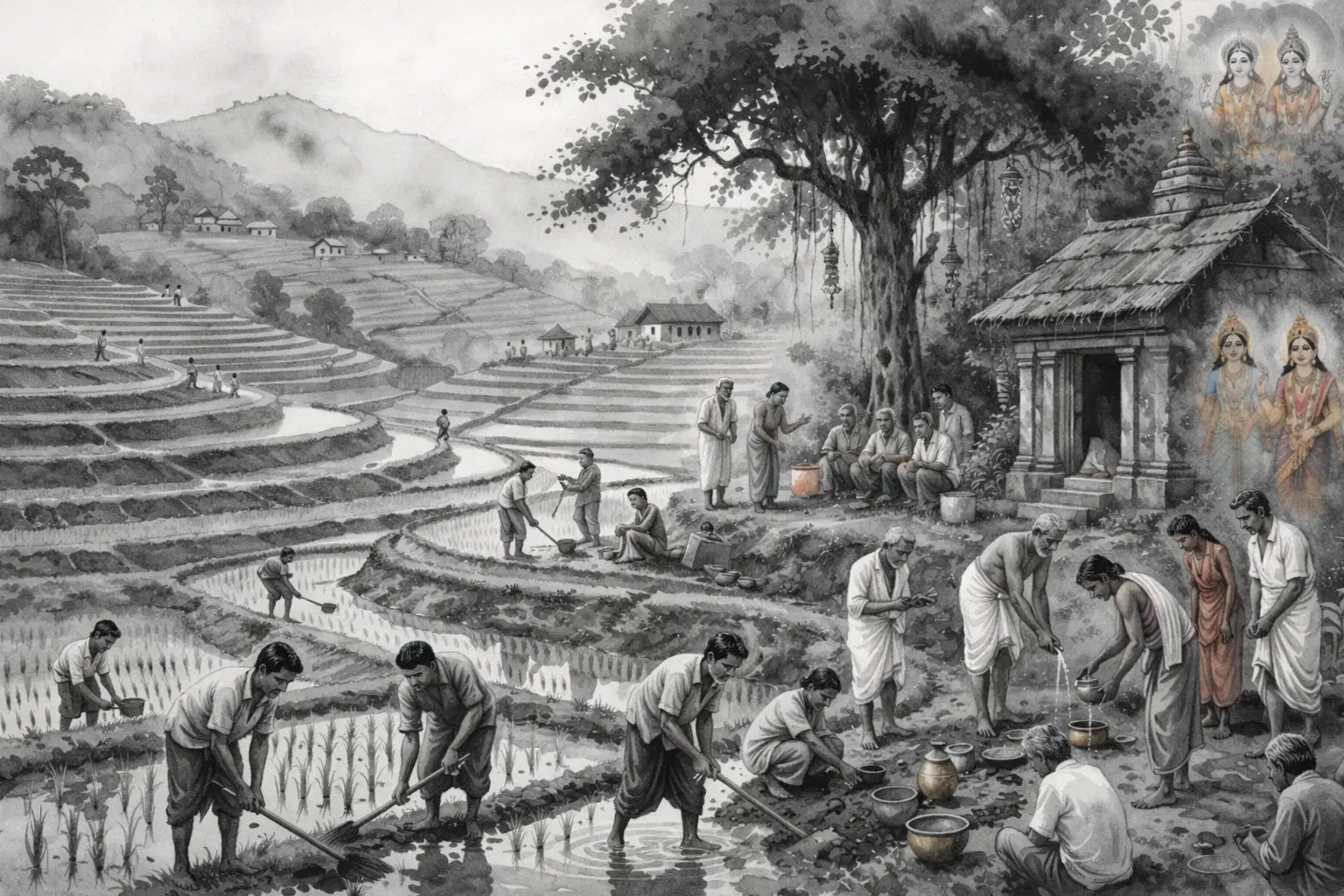
The Hajongs are a Scheduled Tribe community living mainly in the Garo Hills, Meghalaya. Despite being officially recognized as a Scheduled Tribe, the Hajong community continues to face neglect and exclusion from public services, employment opportunities, and political representation. Their marginalization is often sharpened by their identity as Hindus in a largely Christian region.
Traditionally an agrarian community, the Hajongs have long depended on rice cultivation. They trace their origins to the plains of Mymensingh (now in Bangladesh) and migrated over time due to floods, economic hardship, and communal tensions. Today, they live as a small community, working to preserve their language, religion, and cultural practices.
The Hajongs practice Hinduism, worshipping deities such as Bishnu, Kali, and Lakshmi, alongside older animistic and folk traditions. Festivals like Pusna, Biswa, and Bastu Puja shape their yearly calendar and reflect deep ties to land, and ancestors.
From schooling and governance to local politics, living in a Christian-majority environment affects many aspects of Hajong life. Some families face pressure to convert, while others struggle to maintain temples, priestly traditions, and festivals that once stood at the centre of their life. As a result, the Hajongs live at a fragile balance between preserving their culture and adapting to their surroundings.
Despite their long history and cultural strength, the Hajongs are largely absent from current academic and policy discussions. Anthropological interest in the community has been limited, partly because they are often seen as having “converted” to Hinduism. This bias, especially the discomfort around studying indigenous communities associated with Hinduism, has contributed to their continued invisibility.
At Bodha, we aim to address this gap and bring attention to the Hajongs’ lived experiences. This project will document Hajong festivals, rituals, livelihoods, and kinship through ethnographic research, oral histories, and visual documentation, creating a lasting record for the community, researchers, and policymakers.