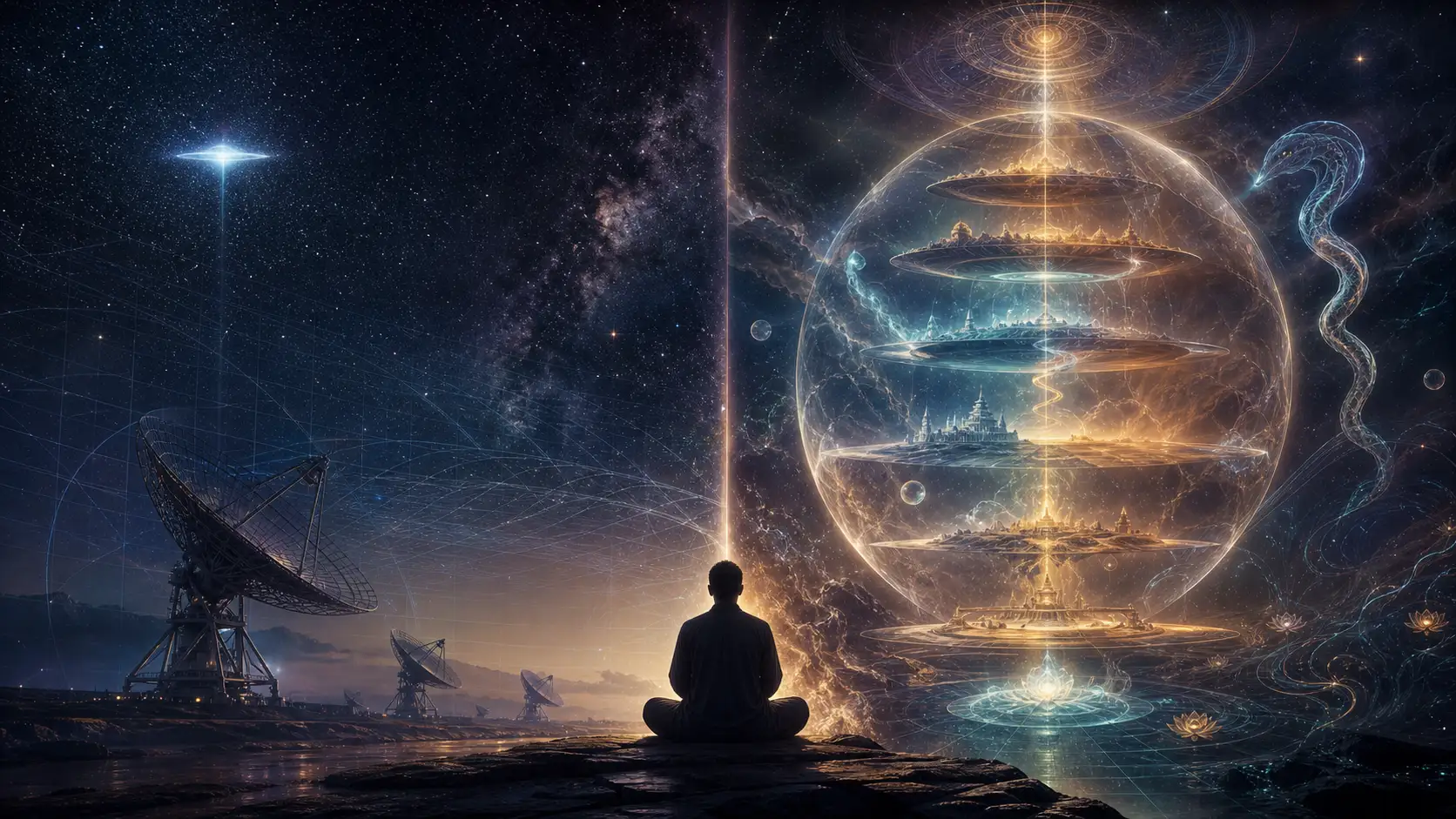
Modern humanity’s search for extraterrestrial intelligence, the UFOs of old and now UAPs (unidentified aerial phenomena) is unwittingly inhibited by a singular assumption that all life in the cosmos will be biological. That it will communicate electromagnetically, and that we will recognize it because it will resemble us in the ways that matter. And so our search for extraterrestrial intelligence (SETI) points radio telescopes at distant galaxies…and waits. The waiting has now lasted decades, and the silence is considered by some philosophically devastating, and by others a confounding paradox. But both devastation and confoundment are the result of asking the wrong question, through the wrong instrument.
And here, in this subcontinent, we’ve been thinking about non-human intelligences for millennia, approaching the question with a framework radically different from the modern materialist one. What SETI calls “extraterrestrial,” the dharmic tradition would call NHI non-human intelligence. And it does not confine these beings to distant physical planets. It maps them onto a multidimensional structure of existence fourteen lokas arranged vertically through the brahmanda cosmic egg each governed by distinct laws of time, physics, and often even karma and metaphysics. To ask whether gods, demons, and celestial musicians are “real” in the way a carbon-based organism might be is to collapse a sophisticated alternate ontology onto an inhibiting and crude one.
The dharmic paradigm is equipped with the certainty that consciousness is the substrate of all existence, and that conscious beings arise wherever the conditions for a particular vibrational density are met. And the classification system for these beings uses guna and dharma qualities and cosmic duties as the axes on which every entity is placed.
Indeed, this is why even the devas are not “gods” in the abrahamic sense. They are not “omnipotent,” not eternally benevolent, and emphatically shy of and distinct from the Absolute. They are highly advanced “extra-dimensional” beings, occupying Svarga and other lokas. They govern the cosmic order rta experience emotions, fears, and ambitions recognizable to humans, though they are in the cosmological sense far above us. Their lifespans are vastly longer than ours, though we may well understand them as “extra-tempestrial” from our vantage. Their capabilities vastly exceed ours, but they are conditioned beings. They exist within the samsara, and they can fall.
Along the same lines, “asuras” are not “demons.” The term carries a meaning of ‘lord’, or ‘with divine strength.’ It was applied to Varuna himself. Though we would today recognize him as a deva, not too long ago he was Asura Medha, the prime among asuras, and is remembered by our cousins the Zoroastrians as Ahura Mazda. As the dharmic tradition deepened its understanding of cosmic dualities, the asuras came to represent the forces of material expansion, of ambition without restraint, of power pursued without adequate recognition of rta. This, more than Abrahamic notions of morality, makes them “evil” or rather beings of darkness. But the easy parallels end there, for Hiranyakashipu was deeply devoted, Mahabali genuinely righteous, and Ravana an unparalleled Shiva-bhakt. Their darkness is unchecked ego’s refusal to accept its place and duties within the hierarchical structure of existence.
And so the Hindu cosmos both has, and has not, villians. It has beings at various stages of understanding their own nature, colliding with the consequences of that misunderstanding within a metaphysics of karma, reincarnation, and temporal cyclicalities.
These are important considerations on the contemporary NHI question. Modern UFO literature which has exploded since the 2017 Pentagon disclosures and the 2023 Congressional testimonies is almost entirely captivated by a good/evil binary. Are the visitors benevolent? Are they hostile? Are they here to harvest our souls and probe our cavities? Are the Greys the same as the Reptilians? And are the Nordics a separate faction? The underlying anxiety here is the anxiety of a tradition sans the sophisticated ontology of non-human beings, improvising one in real time, borrowing from science fiction and its own technological context. Because nothing appropriate exists in the dominant Western philosophical inheritance.
The appropriate philosophical inheritance is pre-endowed with a resolving paradigm. The cosmos is teeming with beings at different stages of evolution, occupying different lokas. From the homo sapien point of view, some are benevolent. Some are predatory. Some are neutral. The Yakshas guard nature and wealth they can be encountered with something close to equanimity if approached with knowledge. Rakshasas disrupt sacrifice and consume without limit egging us in myriad ways to follow them, and feeding on our own material lusts. Gandharvas possess the knowledge of vibrations and melodies so advanced it operates on the frequences of creation itself. Nagas hold serpent wisdom and energy in the subterranean realms the Adholokas which are described in the Puranas as materially more opulent than the “upper” worlds.
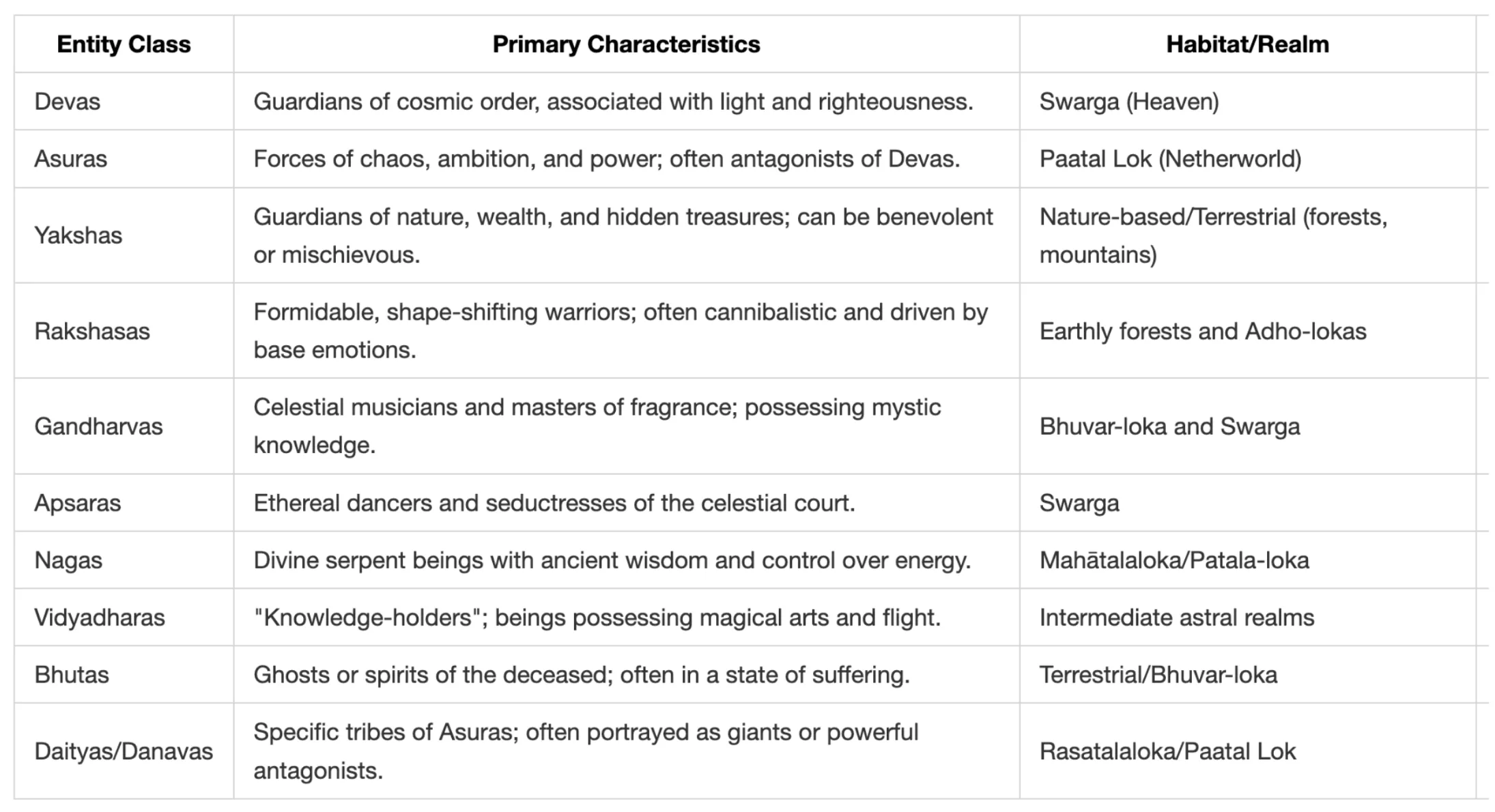
These Adholokas atal, vital, sutal, talatal, mahatal, rasatal, patal are inhabited by Daityas, Danavas, Nagas who possess incredible architectural and technological capacities. Maya Danava, who rules Talatal, is the architect of Danavas, a figure of such technical sophistication that he built the aerial city of Dvaraka, constructed the assembly hall of the Pandavas, and served as the master architect of an entire cosmic civilization. These beings are not to be dismissed as primitive story figures, and they transcend their temporal historicizations. They are a tradition’s attempt to account for the reality of beings with superior material knowledge but no proportionate spiritual equanimity.
This distinction matters, for we have tended in modernity to conflate technological sophistication with wisdom. But dharma has not made this error.
So while we cannot quite ask for a star-map of the loka system, as if it’s a realm to navigate within the bounds of spacetime, we may indeed investigate what kinds of truth it nevertheless encodes. The fourteen lokas describe a universe ordered by vibration and consciousness-density. Bhuloka or Earth, or the material and observable universe of spacetime is the middle realm. The realm of karma and material embodiment. Above it, seven Urdhvalokas ascend through states of increasing spiritual refinement Bhuvar, Svar, Mahar, Jana, Tapo, and Satya. Each is populated by beings whose lifespans lengthen exponentially, and whose modes of cognition and locomotion are proportionately less dependent on physical mechanics. The inhabitants of Maharloka, the great rishis, are understood to live for the Bhuloka-equivalent of millions of years. When this seems absurd to our conditioned minds, we must remember that by a “year” all we mean is the rotational velocity of one particular planet around one particular star in this universe. What’s more absurd is expecting temporal scales outside the material universe to have any “rationally satisfying” proportions to this limited definition. When the fire of cosmic dissolution reaches Maharloka, its inhabitants relocate to Satyaloka. Such a relocation is a practical and metaphysical matter.
Despite our suspicions, from the vantage of modern physics such a cosmology is not as alien as it might appear. The concept of dimensions is inaccessible to ordinary human perception of overlapping layers of spacetimes operating under different physical laws. But it is not foreign to current theoretical frameworks in physics. The loka system simply approaches the problem from the direction of consciousness rather than mathematics. The Yoga Vasishtha, probably the most radical philosophical text in the tradition on this question, distinguishes three kinds of space sthula akasha (gross physical space), chitta akasha (mental space), and cidakasha, the space of pure consciousness that contains all kinds of possible physical universes. A yogi who masters cidakasha can travel to any universe in the multiverse. The story of Lila demonstrates this a devotee of Sarasvati, through the goddess’ grace, enters cidakasha and traverses parallel universes to witness her husband’s lives.
The Yoga Vasishtha also introduces time dilation the observation that a moment and an epoch are relational, varying between observers and realms. When a queen is told that only eight days have passed since her husband’s previous birth, though her own experience felt like lifetimes, the explanation is structural time is an appearance that varies according to the observer’s position in the dimensional superstack. The dharmic root, quite a different system than the Newtonian-Einsteinian one we teach young ones today, produces a structurally similar and comparable insight but approached through the investigation of consciousness rather than the investigation of mass, velocity, gravity, quarks, stranges, charms, and quantum entanglements.
Vimanas, Material vs. Subtle Technology, and Tantra
It would seem that dharmic traditions are insistent aerial vehicles existed, were used in warfare and in travel. The Ramayana’s Pushpaka Vimana, Ravana’s aerial chariot, is a ready example and not to be taken as a metaphor. The Samarangana Sutradhara discusses wooden aircraft with internal fire chambers that heat mercury in ways described as producing lift. The Vaimanika Shastra whatever its complicated modern provenance describes 32 operational secrets of flight, including techniques for invisibility, surveillance of enemy communications, and for viewing into other crafts. Even Kautilya’s Arthashastra mentions the Saubhikas technocrats trained in the art of piloting aerial cities, required to undergo training in both tantra and technical maneuver.
Erich von Daniken, and the UFOlogy school he spawned, took this as evidence of forgotten ancient technology, or direct alien assistance. But the interpretation is intellectually lazy. It outsources ancient India’s stories to a more advanced civilization structurally identical to the colonial claim that Vedic culture itself must have been borne of external stimulus. The “ancient astronaut” theory, whatever its surface-level enthusiasm for Hindu cosmology, repeats an old colonial epistemic error. The more serious question is whether the Vimana tradition describes physical craft, subtle craft, or both and whether that distinction even holds at the levels of technology we are now investigation. The Nath sampradaya, through Shri Matsyendranath and Goraknath, offers a useful counterpoint the siddhas of Siddhaloka travel through space at will without any vehicles, their physical bodies capable of the flight of a bird through the specific yogic perfection called “laghima.” The Srimad Bhagavatam describes these beings as possessing brains superior to manushyas (homo sapiens), mastery of all either yogic perfections, and the capacity to travel between planets as casually as one might cross a room.
The tradition holds that both material technology and subtle technology are real. And the ceiling of the latter far exceeds anything the former could imagine achieving.
The rationally schooled among us, at this point, would rightly be wondering to the epistemology. How do we know these things? Or as it may be put in dharmic terms what is the pramana? The vast, not entirely regimented, and in various streams highly esoteric, tradition of tantra provides us with protocols for contact with non-human intelligences yakshini sadhanas, yogini sadhanas, contact traditions of 64 yoginis these represent what we may describe as empirical methodologies for inter-dimensional/extra-tempestrial encounter. They aren’t “prayers” in the abrahamic sense, nor even simply worship or puja. They are procedures. Specific mantras, specific timings, specific preparatory disciplines, under specific initiation rules these yield specific expected phenomena (with specific risks).
And tradition is candid about these risks. Yakshinis operate on different scales of space and time, described as far more powerful than humans. Improper performance of their sadhanas is dangerous, because the beings contacted have interests and capacities far exceeding those of the practitioner. The monastic codes of tantric Buddhism include penalties for intercourse with a yakshini, equivalent to those for intercourse with a human woman telling us something about how literally these encounters are understood. Some Sri Vidya schools teach the practices as shortcuts for material prosperity and sensual gratification.
What the yogini traditions encode is something that modern UFO literature is gradually, clumsily, moving toward the recognition that non-human intelligences can be engaged, that engagement follows certain regularities, that the encounter alters the practitioner or experiencer in ways that are not always benign, and that the absence of proper preparation protocol leaves the human party vulnerably exposed. The 64 yoginis were worshipped in circular temples open to the sky an architectural form that is of deliberate design. Open to the cosmos, no roof to block transmission. The temples were gateways, and the practices conducted in them involved possession, transmission, and what texts describe as the awakening of the kundalini the serpentine energy coiled at the base of the spine, whose ascent constitutes the practitioner’s own evolution toward the kind of consciousness that can sustain contact with these beings without fracturing.
We of the modern, scientific, rational, and technological world do not have this infrastructure. And so we have encounter reports, abduction testimonies, channeled materials of varying quality, and a conspiratorial disclosure process so cautious it may take decades to acknowledge what ancient human testimonies have long made clear. We have no preparation protocols, and no cosmological frameworks into which non-human encounters could be integrated. We have no tradition of masters who have walked these territories and mapped them.
This is why disturbing alien abductions and fantastical UFO sightings are far more common in the material and technological parts of our world. In the rest, those still connected to humanity’s ancient dimensional farings, people simply encounter deities, protector spirits, ancestral beings, and more.
Dissolving the Boundaries
Modern UFOlogy and comparative religion literature share something in common they treat Hindu cosmology as an “ancient precursor” to modern scientific or philosophical insights. As though the tradition were a rough draft of something modernity is now completing. Though often couched in seemingly complimentary and glowing attitudes, this is patronizing diminishment disguised as appreciation. But the beings Hinduism engages with (as do/have other pagan cultures) are conscious entities, deities with specific attributes, vahanas, and relationships to human psychological and spiritual states. Shani, or Saturn, dispenses justice through karma and operates on a timescale that human life can barely perceive. Rahu and Ketu, the ascending and descending nodes of the moon’s orbit, invisible to the eye, are shadow planets with no physical body. Their existence is a literal and real claim about reality. And by extension that the workings of this universe (bhuloka) are in turn influenced by factors outside its dimensional bounds.
When the Yoga Vasishtha says that the world is as real as a mirage, it’s declaring the nature of reality to be participatory that consciousness is the generating condition of existence, and that the beings who inhabit other lokas are in the dimensional layers of the same consciousness-field we already inhabit, the separation being of vibrational frequencies. And this is a claim that SETI and all of modern UFOlogy cannot make, for their framework does not even begin to anticipate it. Consciousness, in the materialist paradigm, is an epiphenomenon of matter. But in the dharmic view matter is a condensation of consciousness. The inversion is total, and no amount of radio telescopy resolves it.
The question then, of whether we are “alone in the universe” is, from the dharmic perspective, not even coherent. It ignores the combined testimony of all ancient human memory and cultural lore. For what are the Puranas, if not a comprehensive account of ancient Indians’ engagement with divinity and non-human beings of all kinds? Aloneness is in fact impossible in the cosmos, which itself is a modulation of a single, undivided consciousness Brahman, whose nature is sat-cit-ananda and in whom all lokas, all devas, all danavas, all siddhas, all nagas, all yoginis, all manushyas, and all UFOlogists arise and subside the way waves arise and subside in an ocean that is never not itself. On the prospect of “disclosure,” the traditions that have sat with this understanding for millennia observe amused - even with test pilots witnessing flying tic-tacs, or psychically fractured humans being probed by insectoid aliens.
If we were to join with this vast inter-cosmic vision, we already know what’s out there. It’s been mapped. There are established contact protocols, star maps, and navigational markers. And the crafts to help us traverse all this? None other than our own bodies, which when adequately trained, initiated, and prepped can expand their perceptual bandwidths until the thin veils between lokas are pierced to cross through.
The rest is a matter of whether the world is willing to listen to its ancient ancestors, and actually pay attention to what they’ve been saying. Or whether it wants to imagine Sumerians visited by inhabitants of Nibiru, the pyramids built by Grey overlords, and the rocks of Ellora spliced by aliens from a neighbouring galaxy.