

School of Conscilience
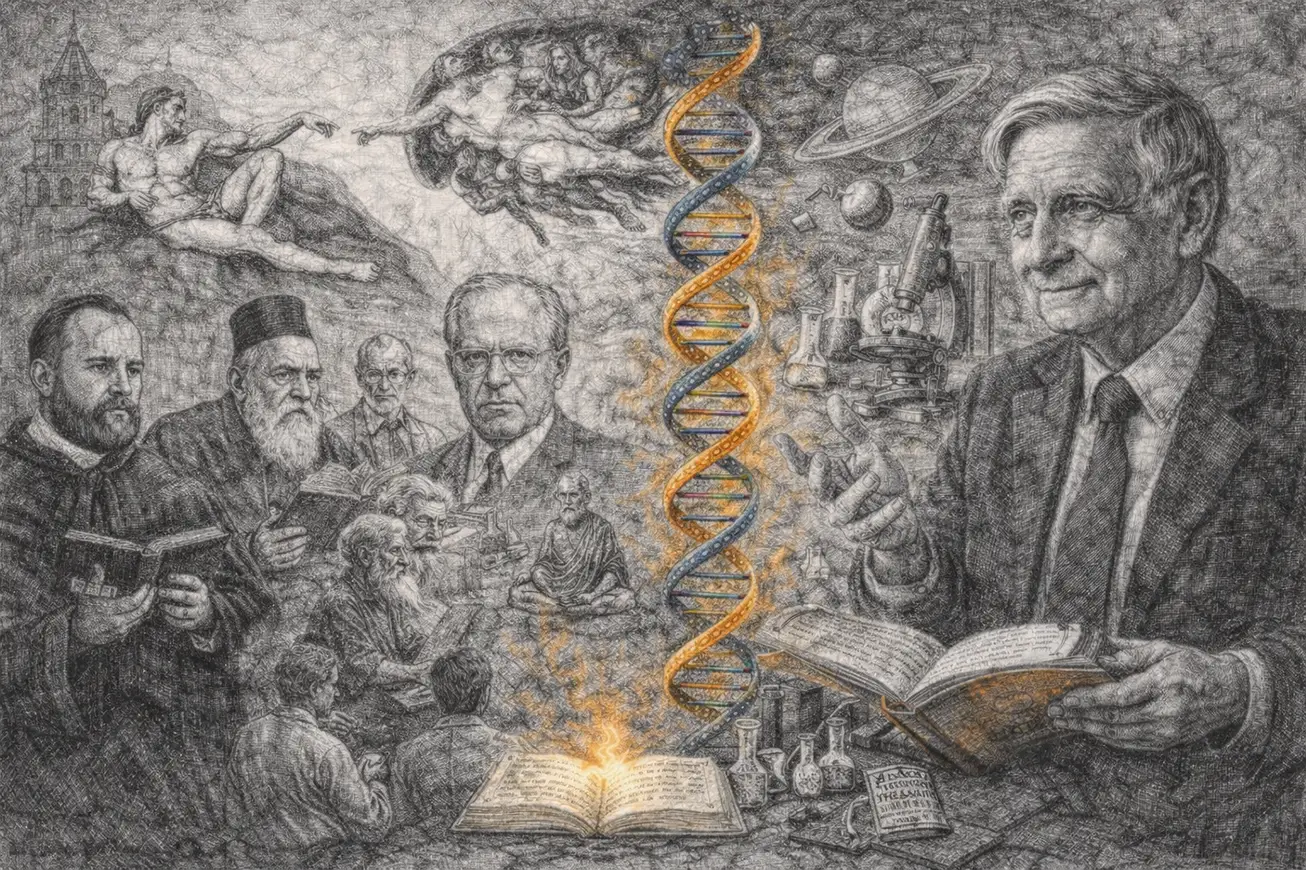
This school holds that the West's divorce between sciences and humanities is a civilizational pathology
The West has a knowledge system problem - the divorce of sciences and humanities. Science in Christian Europe rose as a revolt against religion, because Christianity has no means of verifying the truth claims of its text. It believes in dogma which is unchanging and static. In such a worldview knowledge freezes and ossifies. Science found a way out by creating the experimental method to verify hypotheses. Thus, it gave a reality check to western epistemology and consequently knowledge exploded.
Humanities however carried over many tendencies of Christianity, and most of its disciplines could not develop experimental methodology to verify its hypotheses. This was also because many of these disciplines were invented to ‘prove’ Christianity and thus could not take recourse to experimental methods. Many of these disciplines depended on the intellectual charisma of their founder(s). The more the tour de force of the founder, the deeper currency it gained in society. However most were just flights of fancy of the minds of brilliant thinkers who nevertheless could not or would not rely on experimental methodology. This resulted in a chasm between sciences and humanities which remains to be filled even now, summarised by C P Snow’s ‘Two Cultures’ theory.
Some great scientists and thinkers have tried to bridge this chasm and lend more experimental validity to humanities disciplines. One of the foremost of them is EO Wilson, one of the greatest biologists and scientists to come out of the West in the last century. He created a word ‘consilience’ where he imagined unity of knowledge. A culture like Hindu society which is influenced by advaita and related systems, this idea of unity of knowledge which is organic and not constructed, appeals a lot. At Bodha we are influenced by the consilience paradigm of EO Wilson and try to take inputs from the unified nature of Indian Knowledge Systems.