

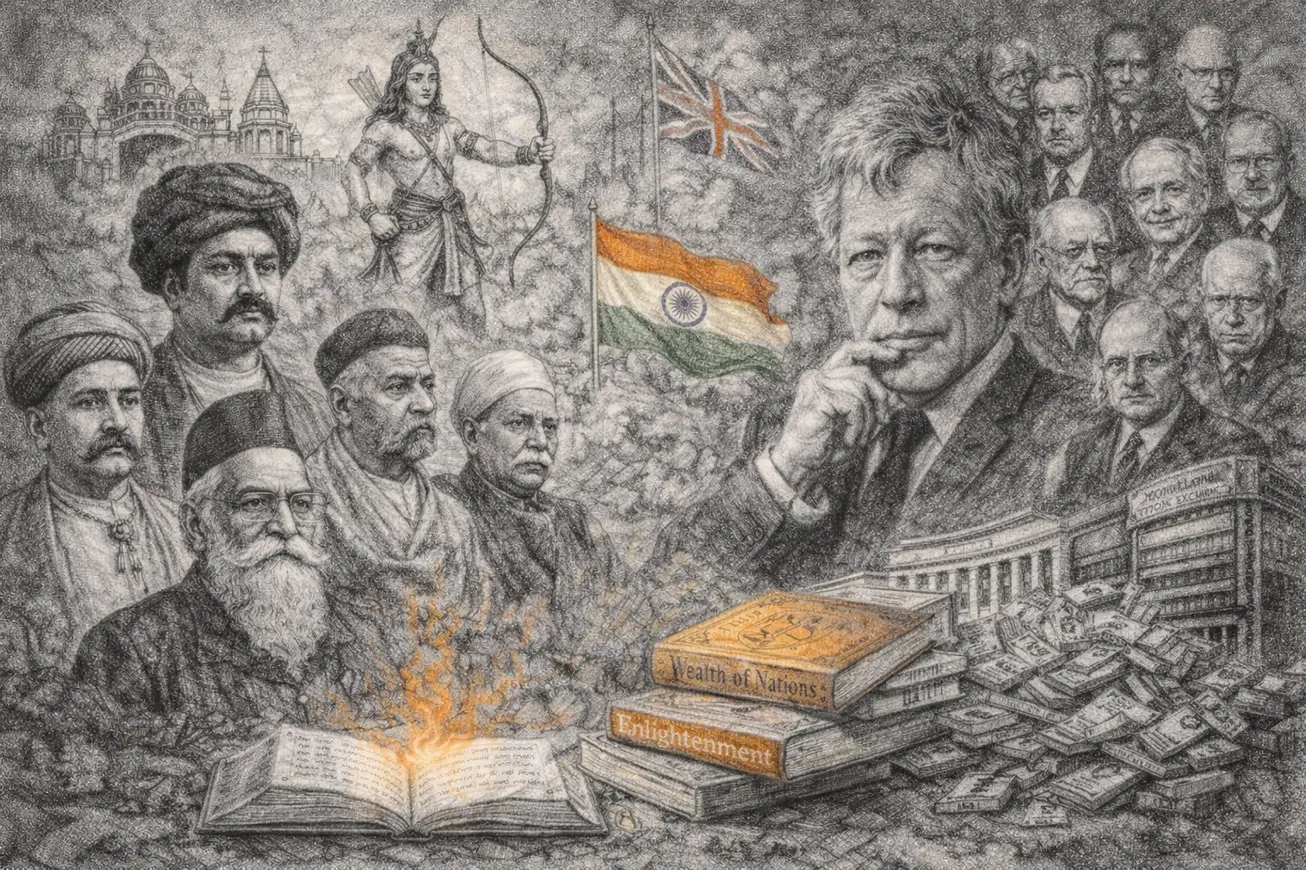
School of Political Traditionalists
A school of Hindu conservatism drawing on Burke, Scruton, and Indian classical statecraft to argue for civilizational continuity over ideological reinvention
Ever since the polity in India’s has veered away from Nehruvian secularism a school of thought has become extremely influential in dictating India’s future and policy. They are broadly called as conservatives or rightists but they are more diverse than these two words suggest. They take inspiration from the Burkian school of conservative thought in the West, currently exemplified by Sir Roger Scruton. But they also build upon the political theories which are instructed in India’s epics and other scriptures.
This group has many shades starting from Raja Ram Mohun Roy who was focused on reforming Hinduism and Indian society by incorporating many elements directly from the political and religious ideology of the British colonialists. On the other hand there are great Hindu nationalists like Bankim Chandra Chatterjee, Bal Gangadhar Tilak and Lala Lajpat Rai who advocated a Hindu revival as the only possible course of a future India. In economics Dada Bhai Naoroji and Romesh Chander Dutt etc. were the representative of this school of thought.
This school of thought had a great Indic thrust during the independence movement of India. But gradually it was overshadowed by first the Gandhians and then the Nehruvian secularists to the point where it was reduced to its economic core. The Hindu nationalists were outshined by their economic counterparts and it became an economic school of thought which became suddenly important in the 90s when India liberalized its market and social sector.
In 21st century with the change of India’s political climate, many great historians, thinkers and leaders on the nationalist side started banding together under this school. It was also a result of the grouping by their political opponents.
The contemporary proponents and followers of this school of thought have good Shatrubodh and have a clear sense of ‘us’ and ‘them’. But their focus is too much on ‘them’ and they lack somewhere in Swayambodha. The overarching idea of this school is the unity of the Hindu society as against its cultural rivals and opponents. Apart from that it advocates adoption of most of the Enlightenment paradigms that come as part and parcel of global democracy.
It also tends to think that political power alone is critical in changing the tide and does not focus much on changing society or culture. They believe that it is completely possible for India’s culture to co-exist with institutions of globalized West and that there is no inherent dichotomy in the two. When such a dichotomy and clash is found they advocate changing society and culture in favour of the modern institutions instead of the other way around.
More than taking inspiration, Bodha seeks to critique the economic thinkers of this school of thought since some of the economic policies of this school of thought are now the establishment paradigm but they are also at loggerheads with ecology and India’s ancient tradition. Though rejecting the secularism of Nehruvian secularists and its political culture, this school of thought has no significant difference in its economic policies from its political opponents which are usually banded together as left-liberals or centrists.
Bodha seeks to critique it. We also seek to illustrate how many of India’s original political traditionalists used conservatism as a prop for their goals and how their thought systems are more nature-conducive than we think.